Cleaning Polluted Soil and Boosting Plant Growth with Helpful Bacteria

Greg Howard
26th June, 2024

Cleaning Polluted Soil and Boosting Plant Growth with Helpful Bacteria

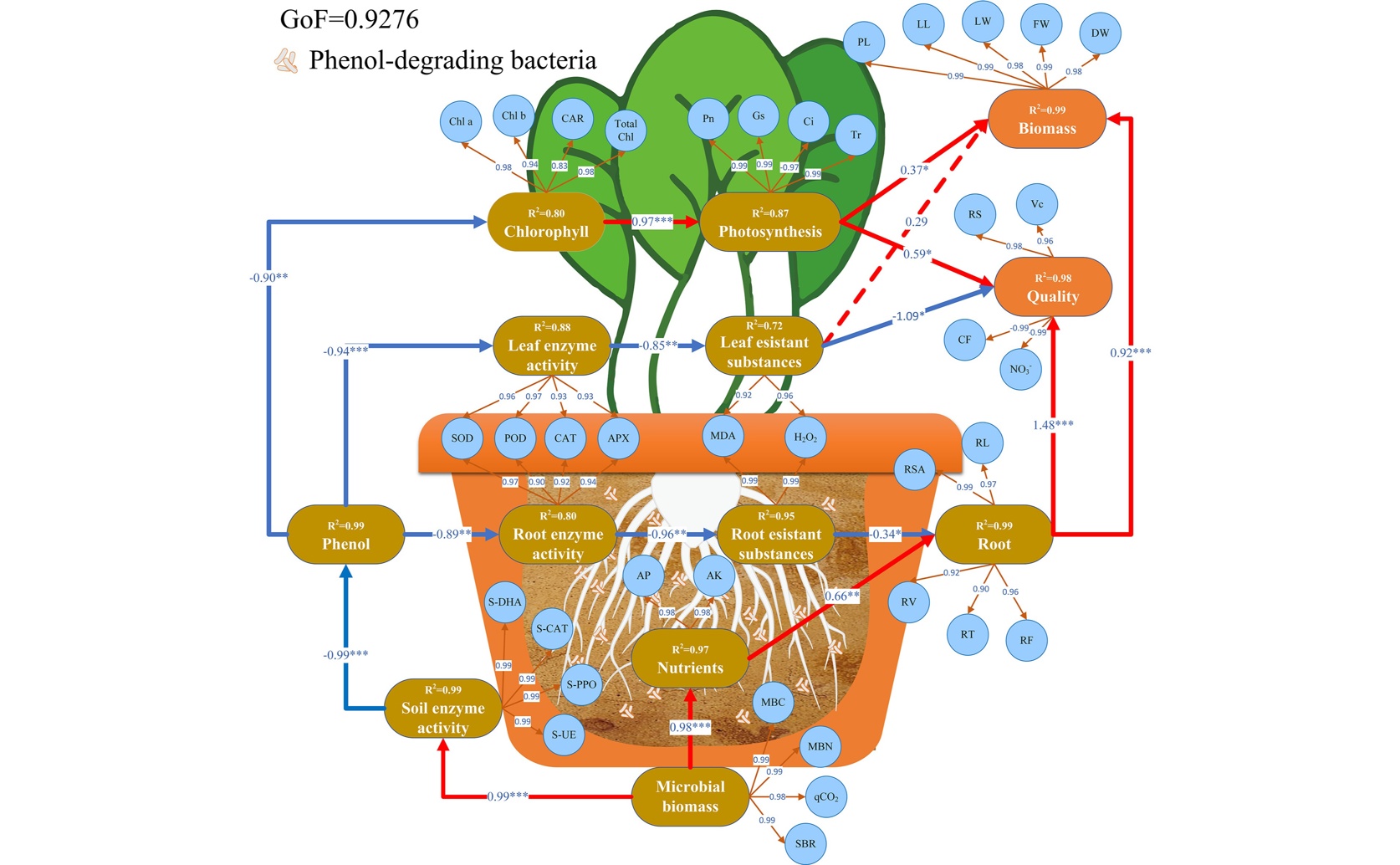
Path analysis reveals that inoculation with Myroides xuanwuensis H13 primarily enhances the growth and quality of Chinese cabbage by stimulating root development, which has a greater impact than its secondary effects on the plant's photosynthetic and antioxidant systems.

Image adapted from: Wang et al. / CC BY (Source)

Key Findings

  • Conducted in China, the study found that the bacterium Myroides xuanwuensis strain H13 can degrade 97.67% of phenol in controlled conditions
  • In soil experiments, H13 removed 89.22% of phenol and improved soil health by increasing nutrient availability and microbial activity
  • The use of H13 enhanced the growth and quality of Chinese cabbage, demonstrating its potential for sustainable agriculture and environmental cleanup
Phenol contamination in soil poses significant environmental and health risks. Traditional physicochemical methods to remediate phenol-contaminated soils are often expensive and inefficient. This study, conducted by Henan Agricultural University, China, explores an environmentally friendly alternative: biodegradation using phenol-degrading bacteria[1]. The research focuses on screening potential phenol-degrading bacteria and verifying the removal capacities of a selected strain, Myroides xuanwuensis strain H13, in a controlled greenhouse experiment. The study utilized Brassica chinensis L. (Chinese cabbage) as the model plant in phenol-contaminated soil. The results demonstrated that H13 has a high degradation capability, achieving a 97.67% efficiency in degrading 100 mg/L phenol under shaking flask conditions. Additionally, H13 facilitated the solubilization of tricalcium phosphate and potassium feldspar powder, which are essential for plant nutrition. Parallel pot experiments indicated that H13 inoculation resulted in 89.22% phenol removal from the soil. This process also enhanced the availability of soil phosphorus and potassium, crucial nutrients for plant growth. The abundance of soil microbes and the activity of soil enzymes significantly increased with H13 inoculation, contributing to improved soil health. Furthermore, the photosynthesis and antioxidant systems in Chinese cabbage were enhanced, leading to increased yield and quality. The findings of this study align with previous research highlighting the potential of biodegradation for phenol removal. For instance, a study on psychrotolerant and psychrophilic bacteria from alpine soils in Iran demonstrated the capability of Pseudomonas sp., Stenotrophomonas spp., and Shinella spp. to degrade phenol efficiently at low temperatures, suggesting the broad applicability of bioremediation in various environmental conditions[2]. Another study focused on the Dulce River in Argentina found high phenol concentrations in the water, emphasizing the need for effective remediation strategies[3]. Moreover, the use of Corynebacterium glutamicum for phenol degradation in soil showed promising results, with over 94% efficiency under optimal conditions. This study also highlighted the importance of reducing residual toxicity in contaminated soil, which was completely removed after three days of treatment[4]. These findings underscore the potential of using bacteria for phenol biodegradation, supporting the current study's approach. The research by Henan Agricultural University expands on these earlier findings by demonstrating the practical application of Myroides xuanwuensis strain H13 in a greenhouse setting. The study's use of Brassica chinensis L. as a model plant provides valuable insights into the potential benefits of bioremediation for sustainable agriculture. By enhancing plant growth and health, this approach not only addresses soil contamination but also promotes crop production, offering a dual benefit for environmental and agricultural sustainability. In conclusion, the study highlights the effectiveness of Myroides xuanwuensis strain H13 in degrading phenol and improving soil health, making it a promising strategy for phenol removal and sustainable agriculture. The enhanced growth and quality of Chinese cabbage following H13 inoculation further emphasize the potential of this bioremediation approach to promote sustainable crop production while mitigating environmental contamination.

EnvironmentBiotechPlant Science

References

Main Study

1) Biodegradation of phenol-contaminated soil and plant growth promotion by Myroides xuanwuensis H13.

Published 25th June, 2024

https://doi.org/10.1128/spectrum.00266-24


Related Studies

2) Biodegradation of phenol by cold-tolerant bacteria isolated from alpine soils of Binaloud Mountains in Iran.

https://doi.org/10.1080/10934529.2018.1553818


3) Evaluation of total phenol pollution in water of San Martin Canal from Santiago del Estero, Argentina.

https://doi.org/10.1016/j.envpol.2018.01.062


4) Treatment of phenol-contaminated soil by Corynebacterium glutamicum and toxicity removal evaluation.

https://doi.org/10.1016/j.jhazmat.2010.06.092


Related Articles

An unhandled error has occurred. Reload 🗙