Rainfall and Soil Affect Formation and Changes of Mysterious Desert Circles

Jim Crocker
26th June, 2024

Rainfall and Soil Affect Formation and Changes of Mysterious Desert Circles

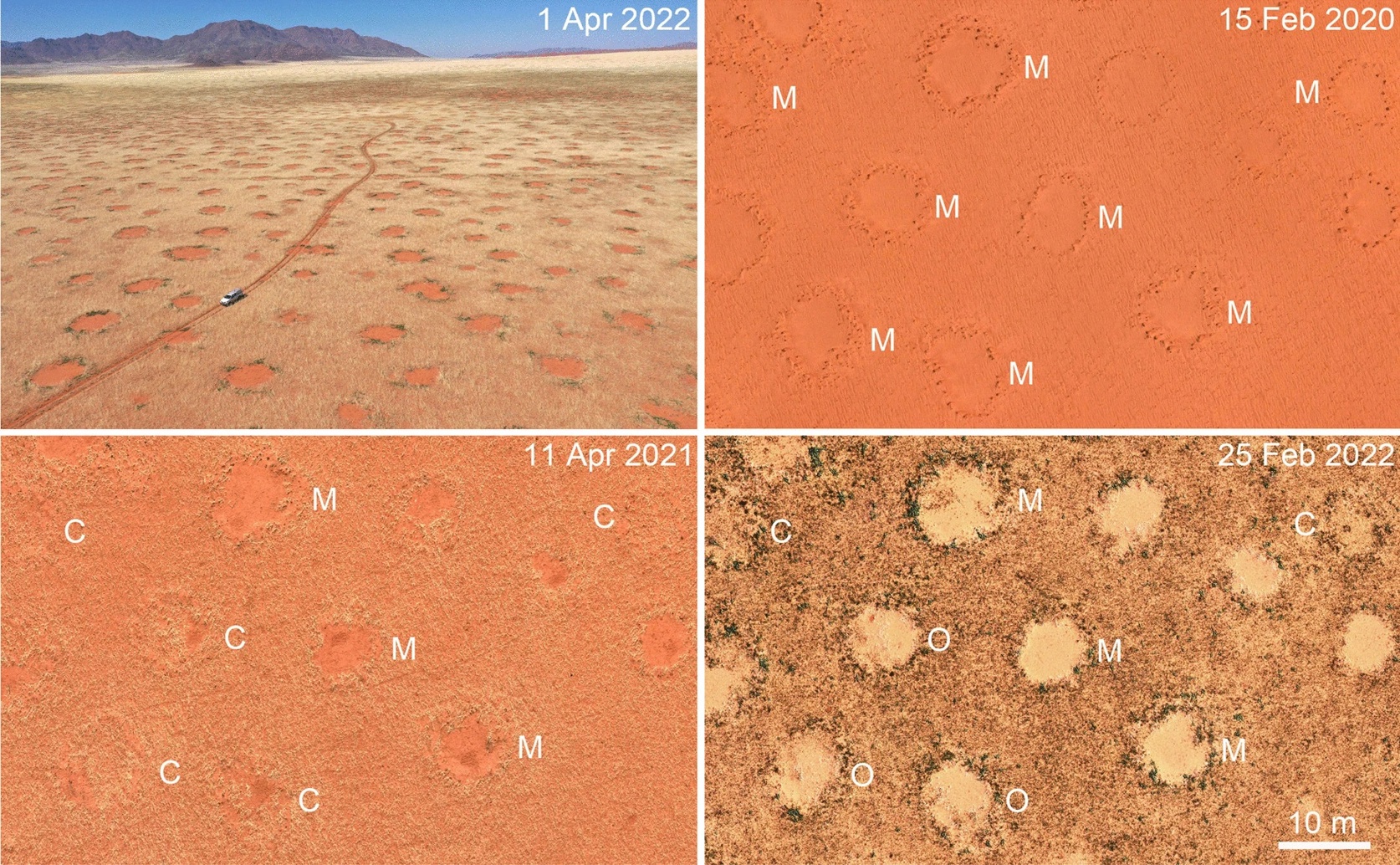
In Namibia's Namib Desert, the life cycle of mysterious "fairy circles" is driven by rainfall, as these bare patches seen during a 2020 drought fill with grass after heavy 2021 rains, only to begin reopening the following year.

Image adapted from: Getzin et al. / CC BY (Source)

Key Findings

  • In Namibia's Namib Desert, fairy circles are created by interactions between plants and soil moisture
  • Barren patches in fairy circles store water, which surrounding grasses use, creating a feedback loop
  • Mathematical models confirm that these patterns result from biomass-water feedbacks and plant self-organization
Fairy circles (FCs) in Namibia's Namib Desert have long intrigued scientists with their strikingly regular, barren patches surrounded by taller grasses. Recent research from the University of Goettingen provides compelling evidence that these formations result from biomass-water feedbacks and plant self-organization[1]. This study aligns with previous findings and offers new insights into the mechanisms behind these enigmatic patterns. The phenomenon of fairy circles has been a subject of intense study, with various hypotheses proposed to explain their formation. Earlier studies have suggested that these patterns arise from complex interactions between vegetation and environmental factors. For instance, one study found that soil moisture within fairy circles decreases from the center to the periphery, indicating that peripheral grasses access moisture that persists longer within the circles[2]. This supports the idea that resource competition and facilitation among plants play a crucial role in shaping these patterns. Another study highlighted the presence of similar vegetation gap patterns in arid regions of Australia, suggesting that such patterns could be more widespread than previously thought. This study emphasized the role of biomass-water feedbacks and water runoff in the formation of these patterns, independent of termite activity[3]. The findings from the University of Goettingen build on this understanding by providing additional evidence that biomass-water feedbacks are central to the formation of fairy circles in Namibia. The research team conducted extensive fieldwork to monitor soil moisture levels and vegetation dynamics within and around fairy circles. They found that the barren patches in the center of the circles act as reservoirs of soil moisture, which is then accessed by the surrounding taller grasses. This creates a feedback loop where the grasses benefit from the moisture stored in the barren patches, while the barren patches are maintained by the grasses' consumption of water. This interplay between vegetation and soil moisture supports the self-organization hypothesis, where plants collectively create and maintain the patterns through their interactions with the environment. The study also incorporated mathematical modeling to simulate the formation of fairy circles. These models confirmed that the observed patterns could emerge from the proposed biomass-water feedback mechanism. The consistency between the model predictions and the actual field observations strengthens the argument that self-organization driven by biomass-water feedbacks is the primary driver of fairy circle formation. Previous research has shown that vegetation patterns in arid and semi-arid landscapes can result from the interplay of positive and negative effects of plants on soil water[4]. This study adds to the growing body of evidence that such feedback mechanisms are not only crucial for understanding fairy circles but also for other similar vegetation patterns in dryland ecosystems. In conclusion, the recent findings from the University of Goettingen provide robust evidence that fairy circles in Namibia result from biomass-water feedbacks and plant self-organization. These results are consistent with earlier studies that have highlighted the importance of resource competition and facilitation in shaping vegetation patterns[2][3]. By integrating field observations with mathematical modeling, this study offers a comprehensive explanation for the formation of fairy circles, contributing to our broader understanding of pattern formation in arid landscapes.

EnvironmentEcologyPlant Science

References

Main Study

1) Spatio-temporal dynamics of fairy circles in Namibia are driven by rainfall and soil infiltrability

Published 25th June, 2024

https://doi.org/10.1007/s10980-024-01924-x


Related Studies

2) Are Namibian "fairy circles" the consequence of self-organizing spatial vegetation patterning?

https://doi.org/10.1371/journal.pone.0070876


3) Discovery of fairy circles in Australia supports self-organization theory.

https://doi.org/10.1073/pnas.1522130113


4) Spatial decoupling of facilitation and competition at the origin of gapped vegetation patterns.

Journal: Ecology, Issue: Vol 89, Issue 6, Jun 2008


Related Articles

An unhandled error has occurred. Reload 🗙