Gene Silencing Can Create Haploid Onions

Jenn Hoskins
25th June, 2024

Gene Silencing Can Create Haploid Onions

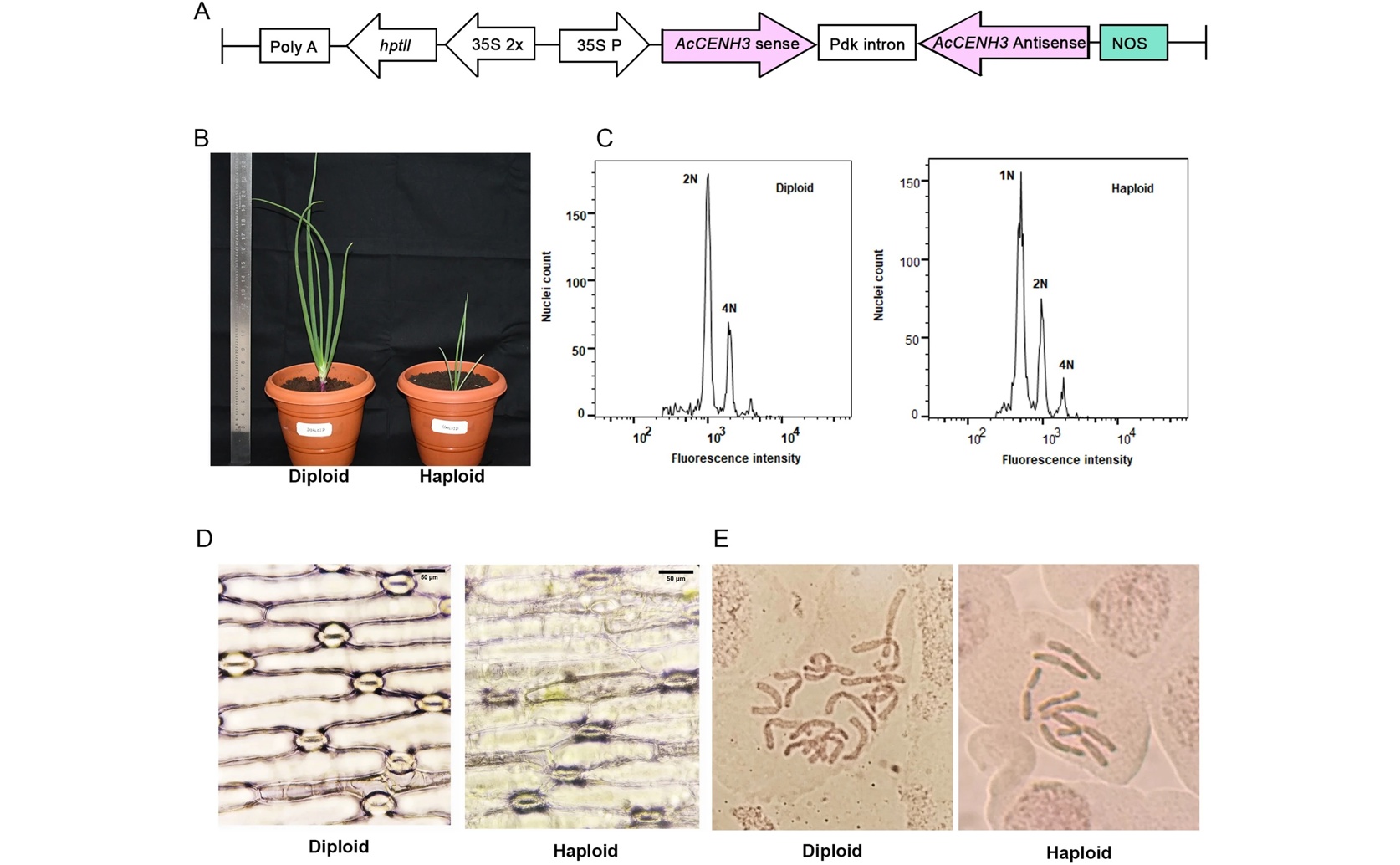
The resulting haploid onion (Allium cepa) plants were confirmed to be genetically and physically distinct, exhibiting shorter stature (b), reduced DNA content (c), smaller stomata (d), and half the number of chromosomes (e) compared to diploid controls.

Image adapted from: Manape et al. / CC BY (Source)

Key Findings

  • Researchers at the ICAR-Directorate of Onion and Garlic Research used a genome elimination technique to speed up onion breeding
  • They downregulated the AcCENH3 gene in onions, leading to selective chromosome elimination and haploid induction
  • This method showed potential for faster breeding by producing haploids, which can be doubled to create homozygous lines, reducing the time needed for developing new onion varieties
Onion breeding, a critical aspect of agricultural development, has long been hindered by the crop's biennial nature and cross-pollination requirements. Traditional breeding methods are time-consuming and labor-intensive, often taking several generations to achieve desired traits. However, recent advancements in haploid induction (HI) offer a promising solution to expedite this process. Researchers at the ICAR-Directorate of Onion and Garlic Research have made significant strides in this area by employing a genome elimination technique based on the centromere-specific histone CENH3[1]. Haploid induction allows for the creation of plants that inherit chromosomes from only one parent, which can then be doubled to produce homozygous lines. This method bypasses the need for multiple generations of inbreeding, thus accelerating the breeding process[2]. In their study, the researchers focused on downregulating the AcCENH3 gene in onions using RNA interference (RNAi) without complementation. CENH3 is a critical protein involved in centromere function, and manipulating it can lead to selective chromosome elimination[3]. The team generated five independent lines of AcCENH3 knockdown onions. However, only three of these lines were able to produce seeds upon self-pollination. These progenies exhibited poor seed set and segregation distortion, and the researchers were unable to recover homozygous knockdown lines. The reduced accumulation of AcCENH3 transcript and protein in leaf tissue correlated with the poor seed set observed in these transgenic plants. When the heterozygous knockdown lines were crossed with wild-type plants, the progenies demonstrated haploid induction by eliminating the chromosomes from the AcCENH3 knockdown parent. The efficiency of HI varied between 0 and 4.63%, with the highest efficiency observed when the E1 line was crossed with wild-type plants. This finding is significant because it demonstrates the potential of CENH3-based genome elimination in producing haploids in onions, a method previously shown to be effective in Arabidopsis thaliana[2]. The ability to generate haploids through CENH3 manipulation has been extensively studied in Arabidopsis, where altered CENH3 proteins lead to selective chromosome elimination during early embryogenesis[3]. This approach has also been used to convert natural tetraploid Arabidopsis into diploids, simplifying breeding by reducing ploidy levels[2]. The current study in onions builds on these findings, highlighting the broader applicability of CENH3-based genome elimination across different plant species. Previous research has shown that haploids can be generated in Arabidopsis through seeds by crossing wild-type strains with transgenic strains that have altered centromeres[4]. This method has been instrumental in accelerating genetic analyses and breeding processes. Similarly, the current study's use of RNAi to downregulate AcCENH3 in onions represents a novel application of this technique, demonstrating its potential to streamline onion breeding programs. The implications of this research are far-reaching. By facilitating the rapid production of doubled haploids, breeders can more quickly develop new onion varieties with desirable traits such as disease resistance, improved yield, and enhanced nutritional content. This advancement is particularly crucial for a biennial crop like onion, where traditional breeding cycles are lengthy. In summary, the study conducted by the ICAR-Directorate of Onion and Garlic Research marks a significant milestone in the application of haploid induction for onion breeding. By leveraging the CENH3-based genome elimination technique, the researchers have opened new avenues for accelerating the breeding process, ultimately benefiting agricultural productivity and food security.

BiotechGeneticsPlant Science

References

Main Study

1) RNAi-mediated downregulation of AcCENH3 can induce in vivo haploids in onion (Allium cepa L.).

Published 24th June, 2024

https://doi.org/10.1038/s41598-024-64432-7


Related Studies

2) Haploid plants produced by centromere-mediated genome elimination.

https://doi.org/10.1038/nature08842


3) Point mutation impairs centromeric CENH3 loading and induces haploid plants.

https://doi.org/10.1073/pnas.1504333112


4) A haploid genetics toolbox for Arabidopsis thaliana.

https://doi.org/10.1038/ncomms6334


Related Articles

An unhandled error has occurred. Reload 🗙