New AI models accurately assess fruit quality

Greg Howard
11th December, 2025

New AI models accurately assess fruit quality

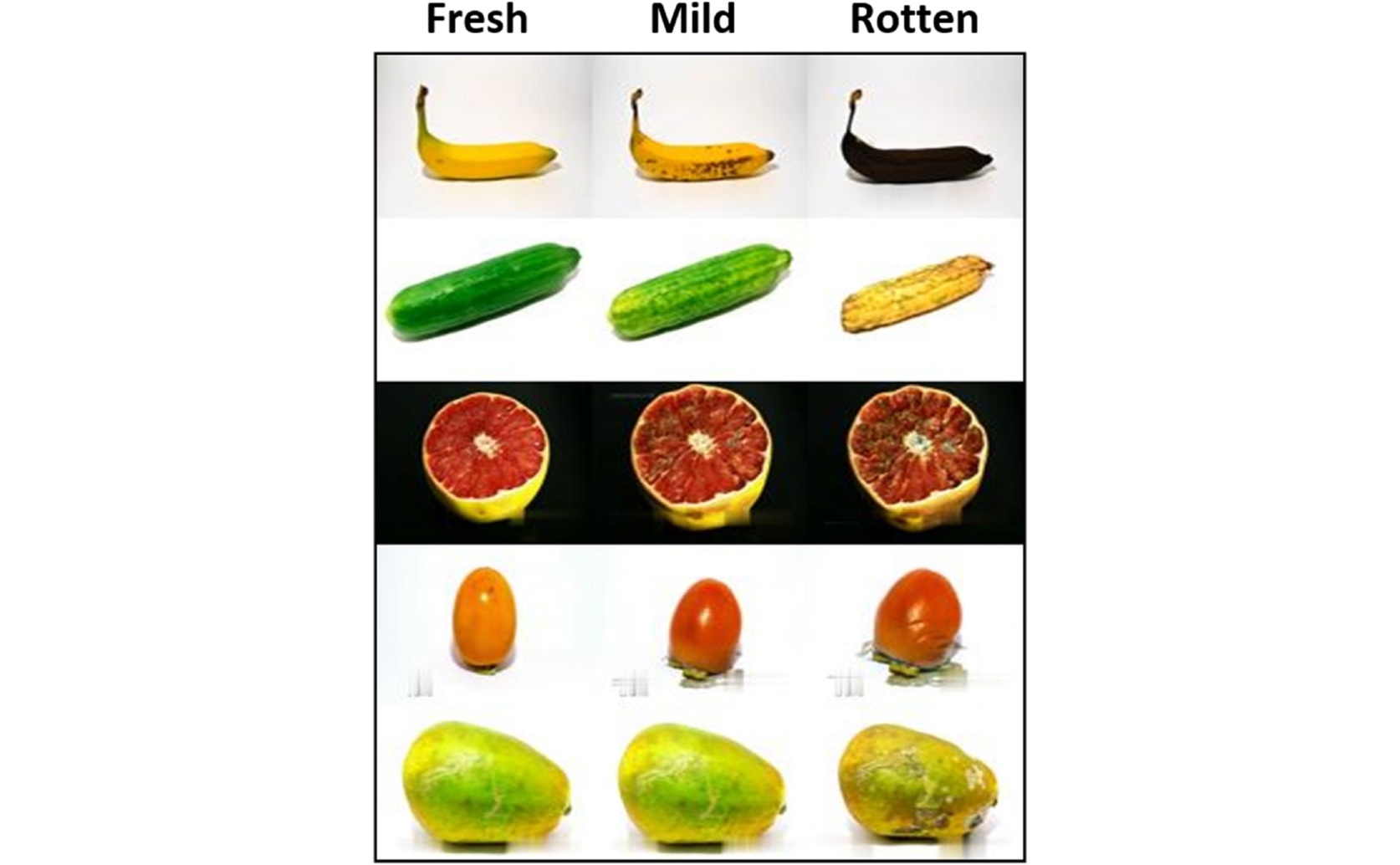
Sample images of FruitQ dataset.

Image adapted from: Khairi et al. / CC BY (Source)

Key Findings

  • Researchers investigated hybrid quantum-classical neural networks for fruit quality assessment, focusing on the impact of different “entangling gate” choices
  • The CZ-based network (NNQEv2) consistently showed more stable training and better generalization than the CNOT-based network (NNQEv1) across multiple datasets
  • NNQEv2 achieved competitive accuracies (up to 98.7%) on standard and custom datasets, demonstrating potential for reliable fruit quality classification even with limited data
Fruit quality assessment is a crucial process in the agriculture and food industries, impacting everything from supply chain efficiency to consumer satisfaction. Traditionally, this assessment relies on manual inspection, which is time-consuming, subjective, and prone to error. Automated systems, utilising computer vision and machine learning, have emerged as promising alternatives. However, these systems often struggle with complex variations in lighting, fruit appearance, and the need for large datasets for effective training. Recent advances in quantum computing offer a potential solution to these challenges, with quantum machine learning (QML) algorithms demonstrating the ability to process information in ways that classical algorithms cannot[2]. Researchers at Federal Urdu University of Arts Science and Technology, King Abdulaziz University, King Fahd University of Petroleum and Minerals, and the Commonwealth Scientific and Industrial Research Organisation have been investigating the potential of hybrid quantum neural networks for fruit quality assessment[1]. Their work focuses specifically on the impact of the “entangling gate” choice – a fundamental component within quantum circuits – on the network’s performance. Quantum computers operate using qubits, which, unlike classical bits, can exist in multiple states simultaneously. Entangling gates manipulate these qubits, creating the complex relationships needed for computation. The study developed two distinct network architectures, NNQEv1 and NNQEv2. NNQEv1 utilized controlled-NOT (CNOT) gates, while NNQEv2 employed controlled-phase (CZ) gates. The choice of these gates isn’t arbitrary. The researchers provided a theoretical underpinning, based on how these gates decompose into fundamental quantum operations and how susceptible they are to errors inherent in current quantum hardware. This analysis suggested that the CZ-based architecture (NNQEv2) would be more stable and less prone to inaccuracies. To test this hypothesis, the performance of both models was evaluated by simulating their quantum circuits on classical computers. This is necessary because fully functional, large-scale quantum computers are still under development. The models were benchmarked against traditional classical machine learning algorithms and state-of-the-art deep learning techniques. The results were highly encouraging. Both NNQEv1 and NNQEv2 achieved competitive accuracies: 98.7% on the MNIST dataset (a standard benchmark for image recognition), 98.6% on the FruitQ dataset (specifically designed for fruit classification), and 96.7% on a custom dataset of Apple images – a dataset intentionally kept small to mimic real-world data scarcity. Importantly, the experimental results validated the initial theoretical predictions. NNQEv2 consistently demonstrated more stable training behaviour, meaning it converged to a solution more reliably, and exhibited tighter confidence intervals during cross-validation – a technique used to assess how well a model generalizes to unseen data. This suggests the CZ-based architecture is indeed more robust to the noise and imperfections present in current quantum systems. This work builds upon previous research in automated fruit recognition, which has often focused on improving image analysis techniques to overcome challenges like variable lighting and background interference[3]. While those methods rely on sophisticated algorithms to extract features from images, they are ultimately limited by the capabilities of classical computers. The study introduces a fundamentally different approach, leveraging the principles of quantum mechanics to potentially overcome these limitations. Furthermore, recent advancements in lightweight deep learning models, such as those using MobileNetV2, have addressed the issue of computational cost and storage requirements for fruit classification[4]. The hybrid quantum neural networks developed in offer a complementary approach, potentially achieving comparable or superior accuracy with different computational demands and a focus on gate-level optimization. The study represents a foundational step in understanding the role of gate-level design choices in quantum machine learning algorithms. It highlights the importance of considering the underlying physics of quantum hardware when developing these algorithms, paving the way for more stable and reliable QML solutions for fruit quality assessment and beyond.

FruitsBiotechGenetics

References

Main Study

1) Hybrid quantum neural network models for fruit quality assessment

Published 10th December, 2025

https://doi.org/10.1371/journal.pone.0332528


Related Studies

2) Machine learning & artificial intelligence in the quantum domain: a review of recent progress.

https://doi.org/10.1088/1361-6633/aab406


3) Apple Fruit Recognition Algorithm Based on Multi-Spectral Dynamic Image Analysis.

https://doi.org/10.3390/s19040949


4) Fruit classification using attention-based MobileNetV2 for industrial applications.

https://doi.org/10.1371/journal.pone.0264586


Related Articles

An unhandled error has occurred. Reload 🗙