How marine parasites and coral larvae navigate using chemical cues

Jim Crocker
28th September, 2025

How marine parasites and coral larvae navigate using chemical cues

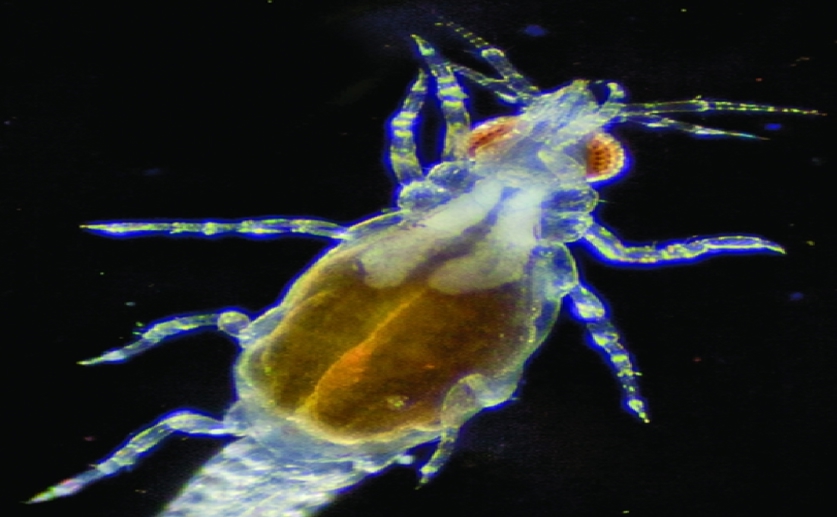
A juvenile Gnathia marleyi, whose chemical search behavior was simulated by researchers.

Image adapted from Figure 1., Franks et al. / CC BY (Source). Original photo by John Artim, Arkansas State University

Key Findings

  • Researchers studied the chemical sensing of a parasitic isopod and coral larvae in Caribbean reefs to understand how they find hosts and settlement locations
  • The study developed a mathematical model, based on “Braitenberg vehicles”, to replicate the organisms’ search patterns, incorporating periods of movement and rest
  • The model successfully captured the essential features of the isopods’ and coral larvae’s behavior, suggesting they use a combination of directed searching and random exploration
Chemical signals play a vital role in how many animals interact, but this area of study, particularly in marine invertebrates, is often overlooked. Researchers at the University of Wisconsin - Milwaukee, University of Miami, University of the Virgin Islands, North-West University, and National Taiwan Ocean University recently investigated the chemical sensing abilities of two ecologically important species: the parasitic isopod Gnathia marleyi and coral larvae Orbicella faveolata[1]. This study focused on how these organisms locate hosts (fish for the isopod) and suitable settlement locations (crustose coralline algae for the coral larvae) using chemical cues. The research team used a specialized instrument called an aquatic olfactometer. This device creates a controlled environment where the organisms can be exposed to chemical signals from their target species – in this case, host fish and algae – and their movements tracked. By observing how the isopods and coral larvae responded to these signals, the researchers aimed to understand the mechanisms driving their chemosensory behavior. One key challenge in understanding chemotaxis – the movement of an organism in response to a chemical stimulus – is that animals don’t move directly towards a source of a smell. They often exhibit periods of random movement interspersed with directed searching. To address this, the researchers developed a mathematical model inspired by the concept of “Braitenberg vehicles”. These theoretical constructs, originally proposed by Valentino Braitenberg, describe simple agents that exhibit complex behaviors based on basic sensorimotor rules. The model incorporated periods of motion and rest for the simulated organisms, guided by the observed behavior of G. marleyi. Crucially, the model also included temporary coupling to the chemical signal gradient, meaning the agent wouldn’t constantly follow the scent but would alternate between focused searching and more random exploration. The simulated trajectories generated by this model were then compared to the actual movement patterns observed in the olfactometer experiments. The comparison revealed a favorable match, suggesting that the model effectively captured the essential features of the isopods’ and coral larvae’s chemosensory behavior. This is the first attempt to mathematically model the chemosensory behavior of these two groups of aquatic invertebrates, providing a framework for further investigation. This study builds upon a broader understanding of how organisms detect and respond to odors, a field that recognizes the importance of symmetrical sensory systems[2]. The existence of two olfactory sensors, observed in organisms ranging from bacteria to vertebrates, likely enhances the robustness of odor detection and localization. The researchers’ use of the Braitenberg vehicle approach also aligns with investigations into the relationship between anatomy, neural circuits, and orientation behaviors, as seen in studies of Drosophila[2]. Furthermore, this research connects to the wider context of environmental noise impacting aquatic life[3]. While not directly addressing noise pollution, understanding the fundamental sensory capabilities of organisms like G. marleyi and Orbicella faveolata is crucial for predicting how they might be affected by increasing anthropogenic noise. If organisms rely heavily on chemosensory cues, disruptions to those cues – potentially caused by noise-induced changes in water chemistry or behavioral alterations – could have significant consequences for foraging, reproduction, and overall fitness. The study also touches on the ecological roles of parasites, which are increasingly recognized as important contributors to biodiversity and ecosystem function[4]. Gnathia marleyi, as a parasitic isopod, plays a role in the dynamics of marine ecosystems, and understanding its host-finding behavior is essential for comprehending its ecological impact. The research highlights the need for more investigation into the complex interplay between parasites, hosts, and their environment. The researchers acknowledge that this study represents a first step, and future work should focus on observing and modeling these organisms’ behavior in three-dimensional space. This would provide a more realistic representation of their natural environment and allow for a more detailed understanding of their chemosensory capabilities.

EcologyMarine BiologyEvolution

References

Main Study

1) Observation and simulation of chemically mediated searches in marine zooplankton

Published 26th September, 2025

https://doi.org/10.1371/journal.pone.0333274


Related Studies

2) Mechanisms of odor-tracking: multiple sensors for enhanced perception and behavior.

https://doi.org/10.3389/fncel.2010.00006


3) Sound the alarm: A meta-analysis on the effect of aquatic noise on fish behavior and physiology.

https://doi.org/10.1111/gcb.14106


4) Parasites as drivers of key processes in aquatic ecosystems: Facts and future directions.

https://doi.org/10.1016/j.exppara.2017.03.011


Related Articles

An unhandled error has occurred. Reload 🗙