Unique Viruses Shape Their Spread and Evolution in Underwater Hot Springs

Jim Crocker
4th May, 2025

Unique Viruses Shape Their Spread and Evolution in Underwater Hot Springs

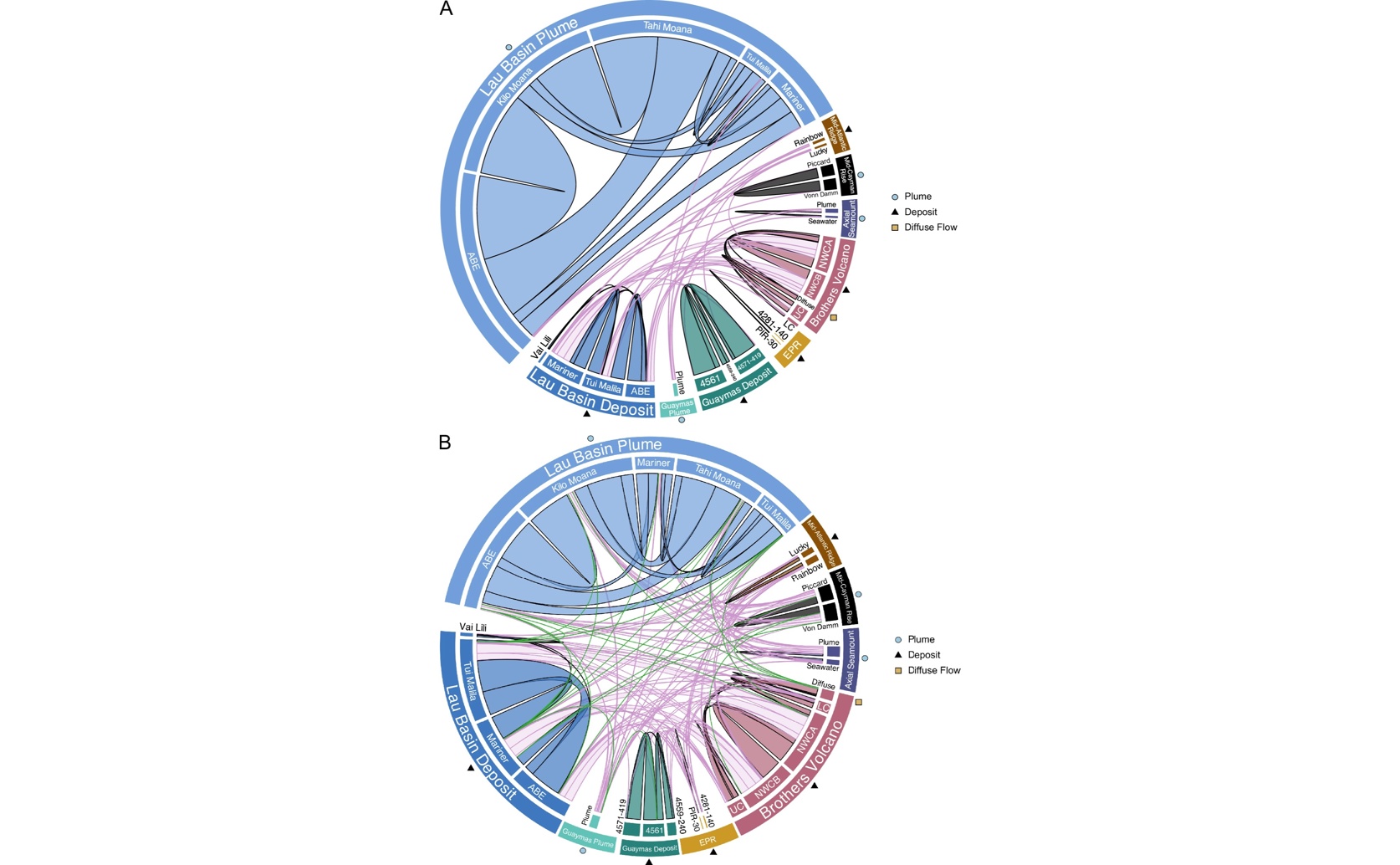
Both average nucleotide identity clustering (a) and read mapping (b) reveal that while hydrothermal vent viruses are highly related within the same vent field, they are rarely shared between geographically distant locations, underscoring the strong endemism that shapes these deep-sea viral communities.

Image adapted from: Langwig et al. / CC BY (Source)

Key Findings

  • Researchers from the University of Wisconsin-Madison studied deep-sea hydrothermal vents worldwide, discovering nearly 50,000 unique viruses
  • Most viruses were exclusive to specific vent locations, showing that viral communities are highly specialized to their environments
  • A few viruses were found in distant vents, indicating some shared essential functions despite geographical separation
Viruses play a crucial role in the ocean's ecosystems, influencing everything from microbial populations to global biogeochemical cycles[2]. Despite their abundance, understanding of viral diversity and ecology in specific environments remains limited. A recent study from the University of Wisconsin-Madison[1] sheds light on the viral communities in deep-sea hydrothermal vents, revealing new insights into their diversity, distribution, and ecological impact. Deep-sea hydrothermal vents are extreme environments where heated, mineral-rich water emerges from the ocean floor. These vents host unique microbial communities that thrive in conditions of high pressure and temperature. The study identified nearly 50,000 viruses from 52 hydrothermal vent samples collected globally, reconstructing over 5,700 viral genomes, mostly bacteriophages—viruses that infect bacteria. This extensive cataloging highlights the significant diversity of viruses in these environments, building on previous findings that oceans house an estimated 10^30 viruses, influencing marine life and biogeochemical processes[2]. One of the key discoveries of the study is the high level of endemism among hydrothermal vent viruses. Most viruses were unique to their specific vent locations, indicating that viral communities are highly specialized to their local environments. However, some viruses were found in geographically distant vents, particularly between the Lau Basin and Brothers Volcano in the Pacific Ocean. These shared viruses mostly carried proteins essential for their structure and replication, suggesting that while core functions are conserved, auxiliary functions—such as those involved in host metabolism—are less commonly shared across distant sites. The research also identified the primary microbial hosts of these viruses, which included members of Campylobacterota and Proteobacteria (both Alpha- and Gammaproteobacteria) in deposit samples, and primarily Gammaproteobacteria in plume samples. This aligns with earlier studies showing that viruses significantly influence microbial community composition and drive the evolution of their hosts by introducing new genetic material during infections[2]. The variation in viral hosts across different vent types suggests that the chemistry of the hydrothermal environment plays a critical role in shaping viral ecology and the coevolution of viruses and their microbial hosts. High-throughput RNA sequencing has previously revealed the vast diversity of RNA viruses in marine environments, uncovering millions of RNA virus contigs and expanding our understanding of RNA virus phylogeny[3]. Similarly, the current study emphasizes DNA viruses in hydrothermal vents, highlighting their role in influencing microbial metabolism and biogeochemical cycles. The presence of auxiliary metabolic genes in these viruses indicates that they can reprogram host metabolisms, affecting processes like photosynthesis and carbon cycling, which are essential for oceanic carbon export[4]. This demonstrates that viruses not only control microbial populations but also have a direct impact on global carbon dynamics. The methods used in this study involved metagenomic analysis, where genetic material is directly extracted from environmental samples and sequenced. This approach allows for the identification and reconstruction of viral genomes without the need for culturing viruses in the lab, which is particularly challenging given the vast diversity and specificity of marine viruses. By analyzing samples from various hydrothermal vents worldwide, the researchers were able to compare viral communities across different geographical locations and vent types, providing a comprehensive view of viral distribution and diversity in these ecosystems. The findings from the University of Wisconsin-Madison study expand on previous research by demonstrating that viral ecology in hydrothermal vents is shaped by both local environmental conditions and the evolutionary history of host-virus interactions. The high degree of endemism suggests that these viral communities are finely tuned to their specific vent environments, which could make them vulnerable to disturbances such as deep-sea mining and other anthropogenic changes. This underscores the importance of protecting these unique ecosystems to preserve their microbial diversity and the vital ecological functions they perform. In summary, this study provides a detailed examination of viral communities in deep-sea hydrothermal vents, revealing extensive diversity and specialized adaptations to local environments. By integrating these findings with earlier research on oceanic viral abundance and diversity[2][3][4], it becomes clear that viruses are integral to marine ecosystems, driving microbial evolution and influencing global biogeochemical cycles. The work highlights the need for further research to understand the full extent of viral roles in various marine environments and the potential impacts of human activities on these essential natural systems.

EcologyMarine BiologyEvolution

References

Main Study

1) Endemism shapes viral ecology and evolution in globally distributed hydrothermal vent ecosystems

Published 1st May, 2025

https://doi.org/10.1038/s41467-025-59154-x


Related Studies

2) Marine viruses--major players in the global ecosystem.

Journal: Nature reviews. Microbiology, Issue: Vol 5, Issue 10, Oct 2007


3) Expansion of the global RNA virome reveals diverse clades of bacteriophages.

https://doi.org/10.1016/j.cell.2022.08.023


4) Diversity and ecological footprint of Global Ocean RNA viruses.

https://doi.org/10.1126/science.abn6358


Related Articles

An unhandled error has occurred. Reload 🗙