New Insights Into Genetic Variety From Cell Division Pace

Jim Crocker
6th August, 2025

New Insights Into Genetic Variety From Cell Division Pace

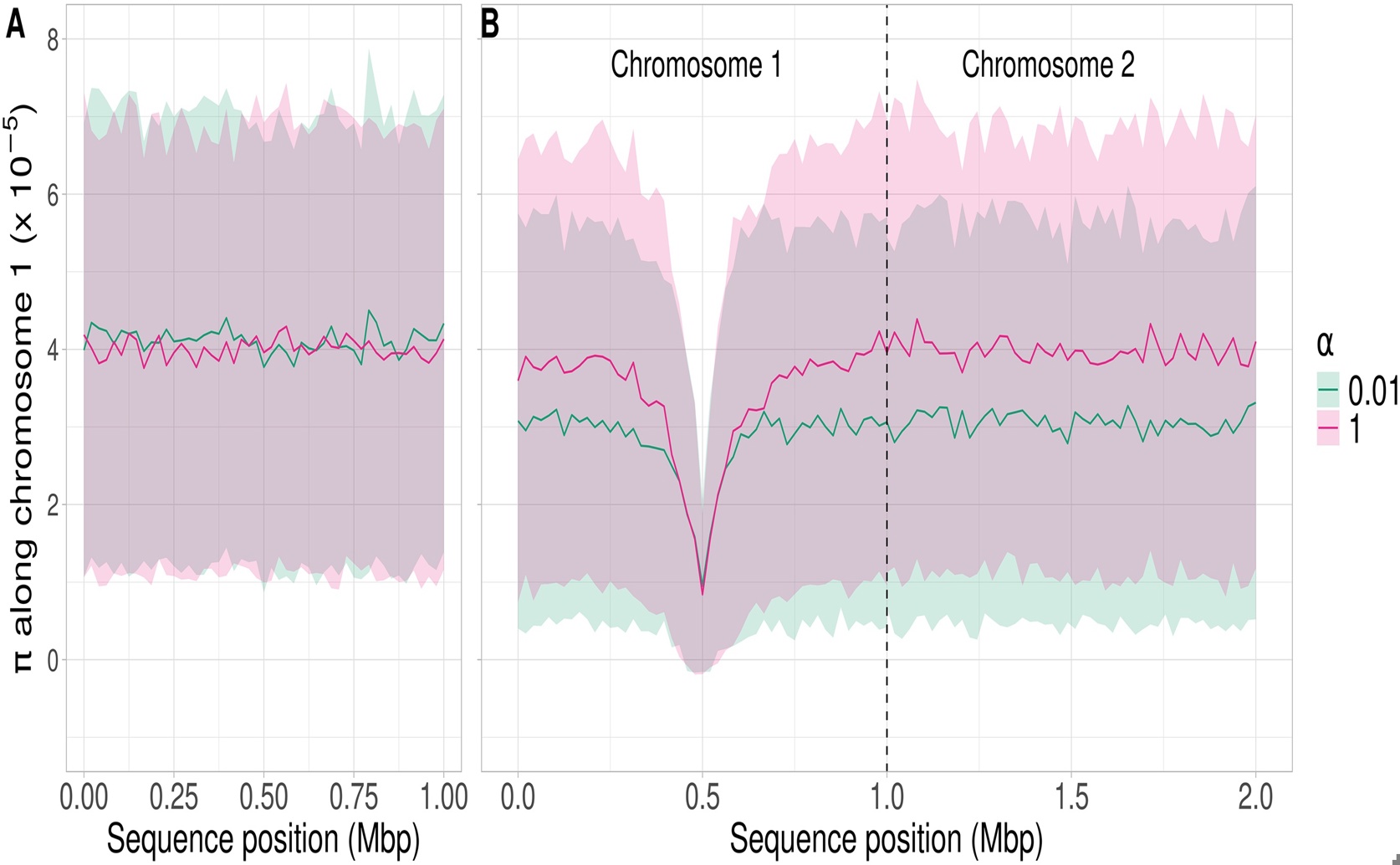
Simulations parameterized for yeast (Saccharomyces cerevisiae) reveal that while neutral diversity is maintained regardless of meiotic frequency (A), a selective sweep under rare sexual reproduction causes a genome-wide reduction in genetic diversity that extends to independent chromosomes (B).

Image adapted from: Ollivier et al. / CC BY (Source)

Key Findings

  • A study on yeast and similar species found that when sexual reproduction is rare, a beneficial genetic change can surprisingly reduce genetic diversity across the entire genome
  • This whole-genome effect occurs because infrequent sex limits gene shuffling, causing beneficial mutations to sweep through the population with linked, neutral DNA
  • Therefore, standard genetic models, which assume constant sexual reproduction, need to be updated to accurately predict how evolution shapes diversity in species with rare sex
Understanding how genetic diversity is shaped within populations is a core aim of evolutionary biology. Traditional models often simplify the process of reproduction, assuming species engage in constant sexual reproduction where genes are regularly shuffled. However, many species, particularly single-celled organisms like yeast, do not fit this mold. They often exhibit facultative sex, meaning they can switch between long periods of asexual reproduction (mitosis, where cells simply divide to create identical copies) and occasional bouts of sexual reproduction (meiosis, where genetic material is recombined and passed on to new offspring). This raises an important question: how does this mixed reproductive strategy influence the genetic makeup of a population, especially when it's adapting to a new environment? A recent study by researchers from Paris-Saclay, CNRS; Edinburgh; and NC State[1] investigated this very question in facultatively sexual, diploid, unicellular species, using yeast as a prime example. This choice of organism is particularly apt, as empirical research on Saccharomyces cerevisiae, the common baker's yeast, has shown that natural populations, such as those found in the broadleaf forests of Taiwan, are "highly clonal and predominantly reproduces asexually in nature"[2]. Despite this predominant clonality, these natural populations harbor immense genetic diversity, comparable to that found across an entire continent, and different genetic lineages can coexist even at very fine spatial scales[2]. This highlights the importance of understanding how such species maintain diversity and adapt given their unusual reproductive habits. The problem the study addresses is that standard population genetic models, which assume continuous sexual reproduction, may not accurately predict patterns of genetic diversity in species that frequently reproduce clonally. In species with facultative sex, many generations of asexual cell divisions can occur before an episode of sexual reproduction, where all individuals might undergo meiosis and then mate. The researchers focused on how factors like the frequency of these sexual events, the rate at which genes recombine during meiosis, and the strength of natural selection on specific genes interact to affect neutral genetic diversity. Neutral genetic diversity refers to variations in DNA that do not directly affect an organism's survival or reproduction, but which can be used as markers to track evolutionary processes. The study found that a single strong beneficial mutation, undergoing what is known as a "hard selective sweep," can have surprisingly far-reaching effects on genetic diversity. A selective sweep occurs when a new beneficial mutation rapidly increases in frequency within a population due to strong natural selection. As this beneficial mutation spreads, it carries along the surrounding genetic material, reducing genetic diversity in that region. What the researchers discovered was that if sexual reproduction is infrequent enough, such a sweep can reduce neutral genetic diversity not just in the immediate vicinity of the beneficial gene, but across the entire genome. This is a significant departure from predictions based on species that reproduce obligately sexually, where the effect of a sweep is typically localized. Furthermore, the patterns of neutral diversity at sites linked to the target of selection were markedly different from what standard models predict. This can be explained by the build-up of what is called "linkage disequilibrium" during long periods of asexual reproduction. Linkage disequilibrium describes the non-random association of alleles (different versions of a gene) at different locations on a chromosome. When organisms reproduce clonally, entire blocks of genes are inherited together without being shuffled, leading to high levels of linkage disequilibrium. This phenomenon is not unique to facultative sex; for instance, studies on self-fertilizing species have also shown that high levels of selfing, which also limits genetic recombination, incurs significant linkage disequilibrium[3]. This can lead to "selection interference," where beneficial mutations might hinder each other's spread because they are tightly linked. Interestingly, the study on self-fertilizing species[3] also suggested that while selection interference is present, high levels of selfing (at least 90%) can actually aid adaptation to a new environment, leading to higher long-term fitness. This suggests that non-standard mating systems, whether selfing or facultative sex, can have complex and sometimes advantageous effects on adaptation, not just limitations. The findings from the main study extend this understanding to facultative sexual species, showing how infrequent sexual reproduction can lead to unique genome-wide consequences for adaptation. The implications of different reproductive strategies extend beyond just genetic diversity patterns. For example, in rotifers, a type of microscopic aquatic animal, differences in reproductive investment (clonal versus facultative sexual reproduction) were found to significantly impact equilibrium population size[4]. Clones that were obligate parthenogens (always asexual) reached substantially higher population sizes compared to cyclical parthenogens (which engage in facultative sex). This demonstrates that the very reproductive strategy of a species, which is itself genetically determined, can have profound eco-evolutionary feedbacks on fundamental ecological variables like population size, which in turn influences the raw material for selection. The researchers used analytical modeling and stochastic simulations to arrive at their conclusions, similar to the methods employed in the study on self-fertilizing species[3]. These computational approaches allowed them to explore the complex interplay of various genetic and reproductive factors over many generations. The study highlights that species with facultative sex are likely to exhibit unusual and distinct patterns of genetic diversity compared to those that reproduce obligately sexually. This research underscores the necessity of moving beyond simplified models to fully grasp the intricate processes shaping evolution in the diverse array of life forms on Earth.

GeneticsEvolution

References

Main Study

1) Beyond recombination: Exploring the impact of meiotic frequency on genome-wide genetic diversity

Published 4th August, 2025

https://doi.org/10.1371/journal.pgen.1011798


Related Studies

2) Extensive sampling of Saccharomyces cerevisiae in Taiwan reveals ecology and evolution of predomesticated lineages.

https://doi.org/10.1101/gr.276286.121


3) Polygenic selection to a changing optimum under self-fertilisation.

https://doi.org/10.1371/journal.pgen.1011312


4) Population regulation in sexual and asexual rotifers: an eco-evolutionary feedback to population size?

https://doi.org/10.1111/j.1365-2435.2011.01918.x


Related Articles

An unhandled error has occurred. Reload 🗙