Finding Life's Tipping Points by Analyzing Connections

Greg Howard
30th July, 2025

Finding Life's Tipping Points by Analyzing Connections

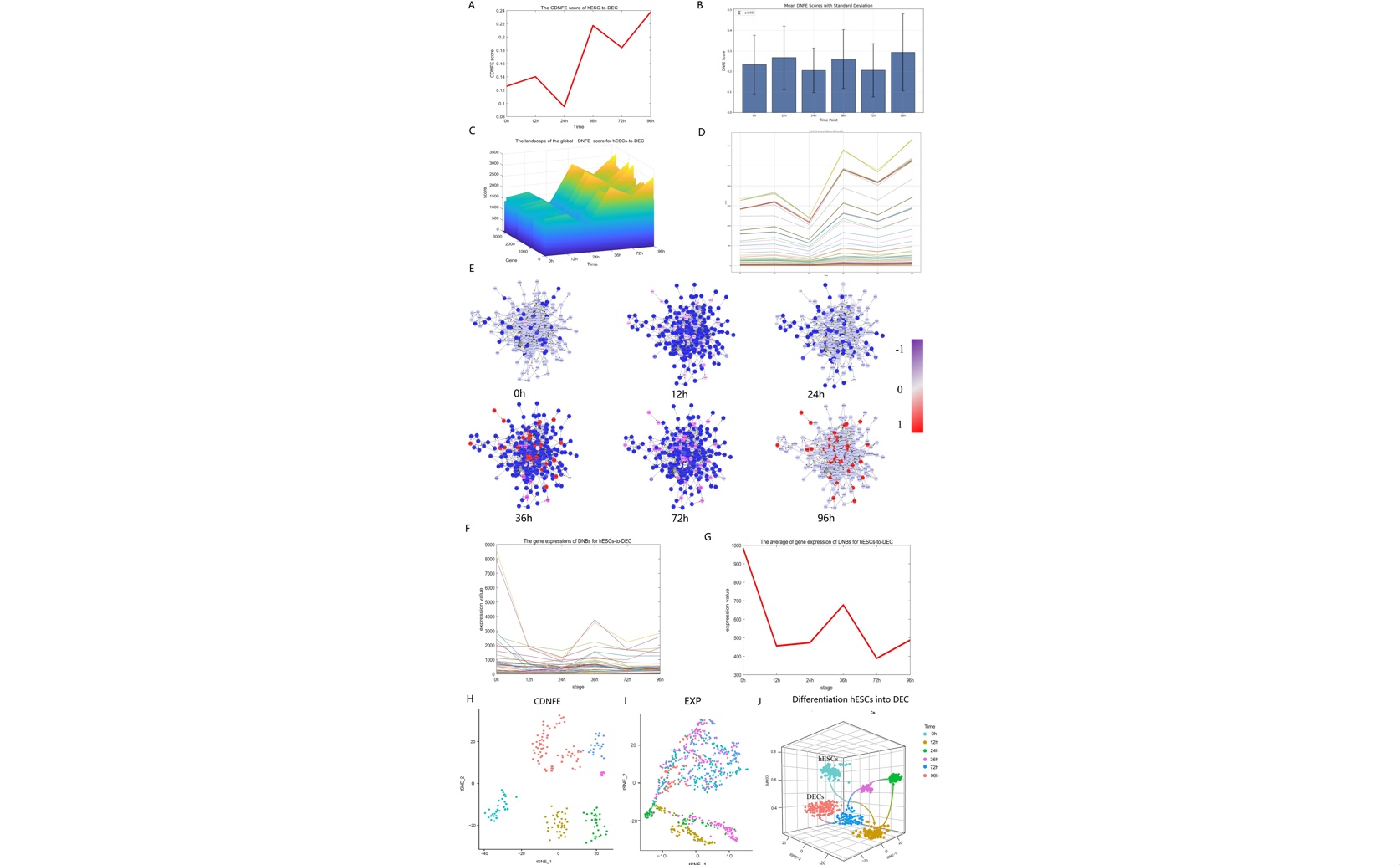
The directed network flow entropy (DNFE) method successfully identified two critical tipping points at 12 and 36 hours during the differentiation of human embryonic stem cells (a–e), demonstrating superior capability in distinguishing cellular states and predicting differentiation trajectories compared to traditional gene expression-based approaches (f–j).

Image adapted from: Peng et al. / CC BY (Source)

Key Findings

  • Researchers at Henan University of Science and Technology developed DNFE, a new computational method to detect critical "tipping points" in biological processes like disease or cell changes
  • DNFE effectively identifies these critical states and previously overlooked "dark genes" in various biological processes, proving more robust and accurate than existing methods across diverse datasets
Biological processes, from the development of an embryo to the progression of a disease, often involve sudden, significant shifts. These are known as "critical states" or "tipping points," where a system rapidly changes from one stable condition to another. Identifying these crucial moments and understanding the underlying biological networks that drive them is vital. For instance, pinpointing a tipping point in disease progression could allow for early intervention, potentially preventing severe deterioration. However, a significant challenge arises when trying to detect these points, especially with modern biological data which is often "high-dimensional" (meaning it contains measurements for thousands of genes or molecules) but "small-sample" (meaning data is available from only a limited number of individuals or cells). Traditional analytical methods, particularly those that rely on "undirected networks" (which show connections but not the direction of influence), frequently struggle with such complex data, especially when analyzing individual cells. To address this challenge, researchers at Henan University of Science and Technology have developed a new computational approach called Directed Network Flow Entropy (DNFE)[1]. This method is designed to transform complex biological measurements, known as "omics data" (such as gene expression levels), into a "directed network." Unlike undirected networks, a directed network not only shows that two elements are connected but also indicates the direction of influence, much like an arrow pointing from cause to effect. This focus on causality is crucial for understanding how biological systems change. The DNFE method is versatile, applicable to both "single-cell RNA sequencing (scRNA-seq)" data, which measures gene activity in individual cells, and "bulk data," which averages gene activity across many cells. The study demonstrated DNFE's effectiveness across six real-world datasets, including three single-cell datasets, two tumor datasets, and a blood dataset. It proved capable of identifying critical states, pinpointing the "dynamic network biomarkers" (specific molecules or genes whose changing relationships signal an impending transition), and helping to uncover the regulatory connections between genes. Computer simulations further showed that DNFE is robust, meaning it performs reliably even with noisy data, and outperforms existing methods in detecting these crucial tipping points. Its ability to handle large networks, up to 1000 genes, also highlights its scalability for increasingly complex biological data. The concept of critical transitions and their detection has been explored in previous research. For example, in early embryonic development, cell fate commitment is considered a critical transition, a drastic shift in cell populations. A computational approach called scGET[2] was developed to predict these impending cell fate transitions using scRNA-seq data. scGET transformed gene expression data into "local network entropy" and "single-cell graph entropy (SGE)" to quantify the stability of gene regulatory networks. Similarly, the Sample-specific Causality Network Entropy (SCNE) approach[3] was introduced to identify critical points or pre-deterioration states in complex diseases by inferring a "sample-specific causality network" for each individual. DNFE builds upon these ideas by also focusing on entropy and causality, but specifically within a directed network framework, which may offer a more precise way to model the flow of information and influence within biological systems. The main study's claim of superior performance over existing methods suggests DNFE could be an advancement on approaches like SCNE. The analysis of single-cell data is particularly challenging. Over 70 tools have been developed for "trajectory inference," which computationally orders single cells along developmental paths[4]. However, comparing their performance is difficult due to varying data requirements and output models. DNFE adds to this landscape of single-cell analysis tools, not by inferring trajectories, but by specifically identifying the critical "tipping points" within them, which are often the most biologically significant moments. The ability of DNFE to work with scRNA-seq data aligns with the growing need for robust tools to analyze large and intricate single-cell datasets, as highlighted in the benchmarking of trajectory inference methods[4]. A notable finding from the DNFE study is its ability to predict active "transcription factors" (proteins that control gene activity) and identify "dark genes." These dark genes are particularly interesting because they are often overlooked by traditional methods, as they don't show significant changes in their overall expression levels. However, they are highly sensitive to the critical state, meaning their activity or relationships within the network change dramatically at a tipping point. This concept of dark genes was also highlighted in the scGET study[2], which suggested that the combined action of dark genes and their downstream targets could be crucial in cell development. DNFE's ability to identify these hidden players, potentially through its directed network analysis, reinforces their importance and provides a new avenue for their discovery. While other methods, such as the Convolutional Neural Network for Coexpression (CNNC)[5], have used deep learning to mine gene-gene relationships and infer causality, DNFE offers an alternative approach based on network flow entropy. Both methods aim to understand the intricate connections and causal influences within biological systems, but through different computational frameworks. DNFE's emphasis on directed networks and entropy provides a mechanistic way to model information flow, potentially offering different insights compared to machine learning models. The development of DNFE represents a significant step forward in our ability to detect critical transitions in biological systems, offering a robust and effective tool for understanding complex processes like disease progression and cell differentiation, even with the challenging high-dimensional, small-sample data that is increasingly common in modern biology.

HealthBiotechEcology

References

Main Study

1) DNFE: Directed network flow entropy for detecting tipping points during biological processes

Published 29th July, 2025

https://doi.org/10.1371/journal.pcbi.1013336


Related Studies

2) scGET: Predicting Cell Fate Transition During Early Embryonic Development by Single-cell Graph Entropy.

https://doi.org/10.1016/j.gpb.2020.11.008


3) Uncovering the Pre-Deterioration State during Disease Progression Based on Sample-Specific Causality Network Entropy (SCNE).

https://doi.org/10.34133/research.0368


4) A comparison of single-cell trajectory inference methods.

https://doi.org/10.1038/s41587-019-0071-9


5) Deep learning for inferring gene relationships from single-cell expression data.

https://doi.org/10.1073/pnas.1911536116


Related Articles

An unhandled error has occurred. Reload 🗙