Boosting Vitamin K1 in Indoor Plants with UV Light

Jenn Hoskins
13th April, 2025

Boosting Vitamin K1 in Indoor Plants with UV Light

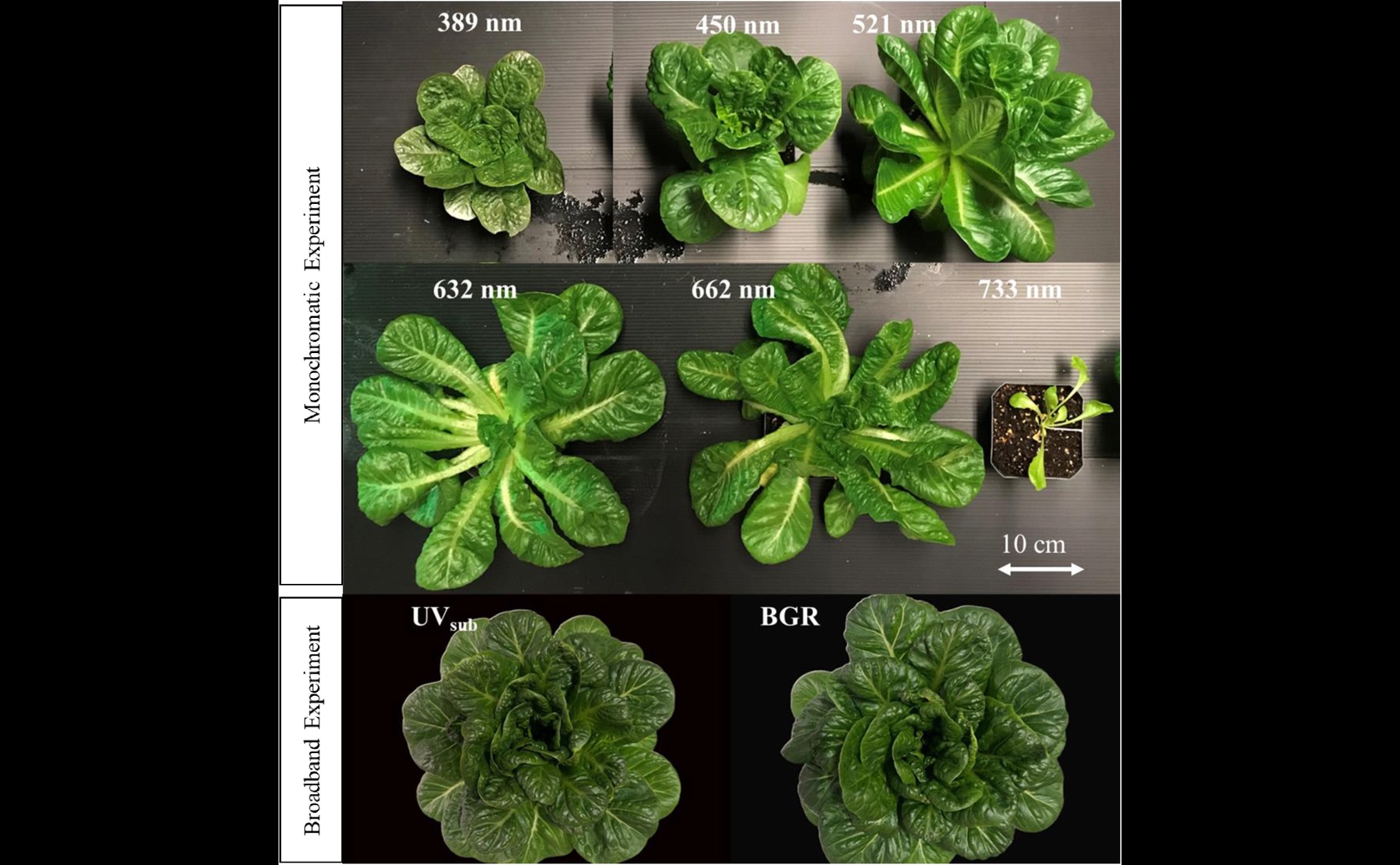
While continuous monochromatic UV light visibly stunted the growth of green romaine lettuce (Lactuca sativa) (top), short-term substitution of UV-A into broadband light near harvest caused only minor size reduction (bottom), demonstrating a viable strategy to enhance phylloquinone levels with minimal impact on plant morphology.

Image adapted from: Kong et al. / CC BY (Source)

Key Findings

  • *Texas A&M researchers found that using UV389 light significantly boosts Vitamin K1 levels in lettuce.*
  • *However, this UV light treatment also caused the lettuce to be 24% smaller in size.*
  • *Balancing UV light exposure can enhance lettuce nutrition while managing growth reductions.*
Maintaining adequate vitamin K levels is essential for various bodily functions, including blood clotting and bone health. Phylloquinone, also known as vitamin K1, is predominantly found in leafy green vegetables like spinach and lettuce. However, its absorption in the human gut is relatively low, making it important to find ways to increase its levels in foods to support better health. A recent study conducted by researchers at Texas A&M University[1] explored how different light qualities can enhance the Phylloquinone levels in lettuce, potentially offering a method to produce more nutritious leafy greens in controlled environments. The study involved two separate experiments using green romaine lettuce grown under customized indoor lighting systems equipped with various light-emitting diodes (LEDs). The researchers measured several growth parameters, including fresh weight, dry weight, leaf area, leaf number, and Phylloquinone levels. Additionally, they assessed photosynthesis rates using photon flux density (PPFD) response curves in the second experiment. In the first experiment, the lettuce was exposed to six different monochromatic light treatments: ultraviolet (UV389), blue (B450), green (G521), red (R632), hyper-red (R662), and far-red (FR733). The results showed that lettuce grown under UV389 light had significantly higher levels of Phylloquinone compared to other light treatments. However, this increase in vitamin K1 came at a cost to vegetative growth, as plants exposed to UV389 exhibited reduced growth parameters. Specifically, the order of vegetative growth from highest to lowest was R632, followed by R662 and G521, then B450, UV389, and FR733. This suggests that while UV389 light can boost Phylloquinone levels, it may negatively impact the overall growth of the lettuce plants. The second experiment focused on the effects of substituting a portion of the broadband light with UV389 during the stationary growth stage of the lettuce. The findings revealed that while the fresh weight of the plants decreased by 24% under the UV_sub treatment, the Phylloquinone levels increased by approximately 175% compared to the control group that received only broadband light. This significant enhancement in vitamin K1 suggests that incorporating UV389 light during specific growth phases can effectively increase the nutritional value of lettuce. However, the decrease in fresh weight indicates a need to balance light exposure to minimize negative impacts on plant growth. The study also found that photosynthesis-related metrics, such as operating photosynthesis (AOP) and light use efficiency (LUE), were lower in the UV_sub treatment. This implies that the increased Phylloquinone levels did not contribute to enhanced photosynthesis but likely provided photoprotection by managing excess energy within the plants. These findings build upon previous research, such as the study by Purdue University on the effects of different LED spectra on red-leaf lettuce[2]. Purdue's research demonstrated that combining white light with blue light improved pigment content and phytochemical levels in lettuce. Similarly, the Texas A&M study highlights the potential of specific light treatments to enhance essential nutrients in leafy greens. Additionally, another study from Wageningen University examined the impact of high-energy blue and low-energy far-red light on romaine lettuce growth and pigment synthesis[3]. This research indicated that while certain light combinations could enhance pigment concentrations, they might also affect overall plant growth. The Texas A&M study aligns with these findings, showing that while UV389 light can significantly boost Phylloquinone levels, it also poses challenges for maintaining optimal vegetative growth. Furthermore, the review from Purdue University on vitamin K forms[4] underscores the importance of different vitamin K types, including Phylloquinone, in human health. This review highlights the need for more research to establish dietary reference values for various vitamin K forms, given their distinct roles and bioavailability. The Texas A&M study contributes to this body of knowledge by demonstrating a method to increase Phylloquinone levels in a common dietary source, potentially aiding in meeting dietary requirements for this essential nutrient. Incorporating advanced lighting technologies in indoor farming could offer a practical solution to enhance the nutritional quality of leafy vegetables. By carefully selecting and adjusting light spectra, it is possible to optimize the balance between plant growth and nutrient accumulation. The Texas A&M study suggests that using UV389 light during specific growth stages can significantly increase Phylloquinone levels, providing a method to produce more nutritionally beneficial lettuce. However, the trade-off between increased vitamin K1 and reduced plant growth must be carefully managed to ensure both high nutrient levels and sufficient biomass. Future research could explore varying the intensity and duration of UV389 exposure to find an optimal balance that maximizes Phylloquinone levels without severely compromising plant growth. Additionally, combining UV389 with other light spectra that promote vegetative growth, as suggested by previous studies[2][3][5], might offer a comprehensive approach to producing highly nutritious and robust lettuce varieties in controlled environments. Overall, the study by Texas A&M University highlights the potential of using specific light treatments to enhance the nutritional content of lettuce, particularly increasing Phylloquinone levels. This approach aligns with ongoing efforts to improve the quality and health benefits of produce grown in indoor farming systems, offering a promising avenue for producing more nutrient-dense vegetables to support public health.

AgricultureNutritionPlant Science

References

Main Study

1) Enhancing phylloquinone levels using ultraviolet-A radiation in indoor farming

Published 10th April, 2025

https://doi.org/10.1371/journal.pone.0319469


Related Studies

2) Supplementary Far-Red and Blue Lights Influence the Biomass and Phytochemical Profiles of Two Lettuce Cultivars in Plant Factory.

https://doi.org/10.3390/molecules26237405


3) Blue and Far-Red Light Affect Area and Number of Individual Leaves to Influence Vegetative Growth and Pigment Synthesis in Lettuce.

https://doi.org/10.3389/fpls.2021.667407


4) The role of menaquinones (vitamin K₂) in human health.

https://doi.org/10.1017/S0007114513001013


5) Short-Term Ultraviolet (UV)-A Light-Emitting Diode (LED) Radiation Improves Biomass and Bioactive Compounds of Kale.

https://doi.org/10.3389/fpls.2019.01042


Related Articles

An unhandled error has occurred. Reload 🗙