Special RNA Helps Fungus Adapt by Changing Shape

Jenn Hoskins
9th March, 2025

Special RNA Helps Fungus Adapt by Changing Shape

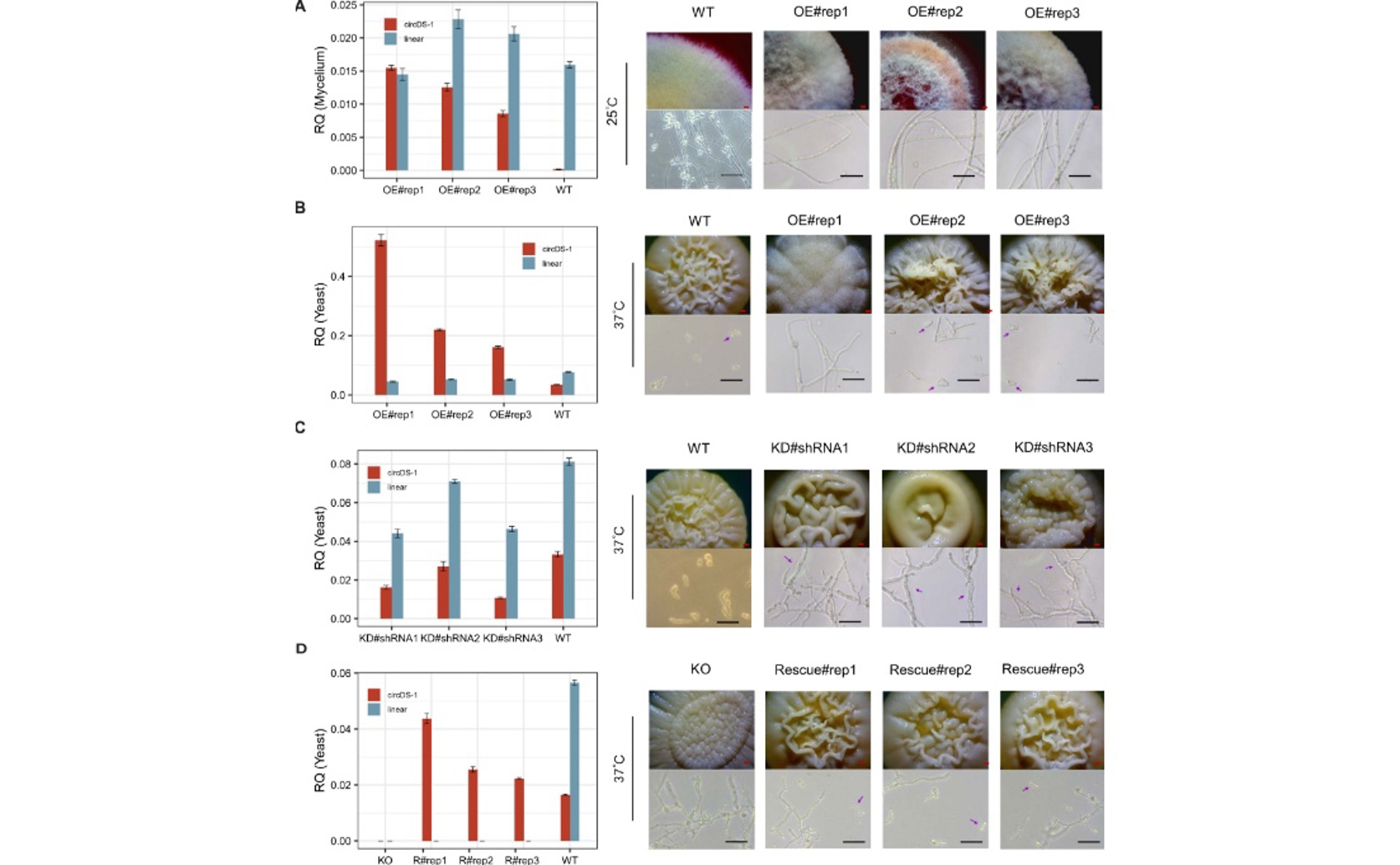
Overexpression of circDS-1 in Talaromyces marneffei resulted in abnormal development in mycelia (a) and yeast (b), while knockdown (c) and rescue assays (d) confirmed that this circular RNA is essential for maintaining the pathogenic yeast morphology independent of its parental gene.

Image adapted from: Hu et al. / CC BY (Source)

Key Findings

  • Researchers at Peking University identified a unique RNA, circDS-1, in the harmful fungus Talaromyces marneffei
  • circDS-1 enables the fungus to switch forms, boosting its ability to infect and cause severe disease
  • Targeting circDS-1 may lead to new treatments for deadly fungal infections
Fungal infections pose a significant threat to human health, especially among individuals with weakened immune systems. Among these, thermally dimorphic fungi are particularly concerning because of their ability to adapt to the human body's temperature, enabling them to cause severe diseases. A recent study conducted by researchers at Peking University Health Science Center[1] sheds light on how these fungi adapt at the molecular level, revealing new insights into their survival and virulence. Thermally dimorphic fungi can switch between two forms: mycelial, which is filamentous, and yeast, a single-celled form. This switch is crucial for their ability to infect and thrive within a host. The study focused on Talaromyces marneffei, a prominent thermally dimorphic fungus responsible for the often fatal disease Talaromycosis. Understanding the mechanisms behind this morphological transition is essential for developing effective treatments. The researchers employed advanced sequencing technologies to map out circular RNAs (circRNAs) in T. marneffei under both mycelial and yeast conditions. CircRNAs are a type of RNA that, unlike regular linear RNA, forms a closed loop. These molecules have been increasingly recognized for their regulatory roles in various biological processes. In this study, the team optimized an integrative pipeline that combined next-generation and third-generation sequencing methods to accurately detect and analyze circRNAs. Their findings revealed that T. marneffei circRNAs are generally shorter, less abundant, and exhibit a preference for circularization during splicing, a process where RNA is cut and rejoined. One particular circRNA, named circDS-1, was found to play a pivotal role in the transition from mycelial to yeast form. Interestingly, circDS-1 functions independently of its parent gene, suggesting that it has a unique role in regulating fungal morphology and virulence. Further investigations demonstrated that circDS-1 is crucial for maintaining yeast cell shape and enhancing the fungus's ability to cause disease. This discovery highlights the importance of non-coding RNA elements in fungal adaptability, a concept previously underexplored in studies of fungal pathogens[2]. By focusing on circRNAs, the research provides a fresh perspective on how genetic regulation contributes to the pathogenicity of fungi. The study also explored how circDS-1 is generated. It was found that a specific region within the intron (a non-coding segment) flanking circDS-1 is unique to T. marneffei. This region facilitates the production of circDS-1, linking genetic mutations in non-coding regions to the functional evolution of circRNAs. Such findings suggest that intronic mutations can drive the development of new regulatory molecules, enhancing the fungus's ability to adapt to hostile environments like the human body. Previous research has highlighted the genetic diversity and adaptability of fungal pathogens[2], as well as the critical role of morphological switching in their pathogenicity[3]. Additionally, studies have shown that fungi respond to environmental stresses, such as heat, through complex regulatory mechanisms[4]. The current study builds on these foundations by demonstrating that circRNAs are integral to the thermal adaptability of T. marneffei, thereby connecting genetic variation with functional outcomes in fungal virulence. Moreover, the research aligns with evolutionary studies that emphasize the importance of understanding the relationships among dimorphic fungal pathogens to improve diagnostics and treatment strategies[5]. By uncovering the role of circRNAs in thermal adaptation, the study not only advances our knowledge of fungal biology but also provides potential targets for antifungal therapies. Targeting circDS-1 or the pathways it influences could lead to new methods for controlling fungal infections. The implications of this research are broad. By revealing a novel molecular mechanism through which fungi adapt to host environments, it opens up new avenues for combating fungal diseases. This is particularly important as fungal infections are becoming more prevalent and resistant to existing treatments. Understanding the genetic and molecular basis of fungal adaptability is crucial for developing effective interventions. In conclusion, the study by Peking University Health Science Center offers significant insights into the thermal adaptability of Talaromyces marneffei. By identifying and characterizing circDS-1, the researchers have uncovered a key player in the morphological and virulence regulation of this pathogen. This work not only enhances our understanding of fungal biology but also paves the way for innovative approaches to prevent and treat deadly fungal infections.

GeneticsMycologyEvolution

References

Main Study

1) Species-specific circular RNA circDS-1 enhances adaptive evolution in Talaromyces marneffei through regulation of dimorphic transition

Published 6th March, 2025

https://doi.org/10.1371/journal.pgen.1011482


Related Studies

2) Genetic Diversity of Human Fungal Pathogens.

https://doi.org/10.1007/s40588-023-00188-4


3) Fungal dimorphism: the switch from hyphae to yeast is a specialized morphogenetic adaptation allowing colonization of a host.

https://doi.org/10.1093/femsre/fuv035


4) Response and regulatory mechanisms of heat resistance in pathogenic fungi.

https://doi.org/10.1007/s00253-022-12119-2


5) Fantastic yeasts and where to find them: the hidden diversity of dimorphic fungal pathogens.

https://doi.org/10.1016/j.mib.2019.05.002


Related Articles

An unhandled error has occurred. Reload 🗙