Genomes from Extinct Butterflies Can Help Identify Declining Insect Species

Jim Crocker
5th October, 2024

Genomes from Extinct Butterflies Can Help Identify Declining Insect Species

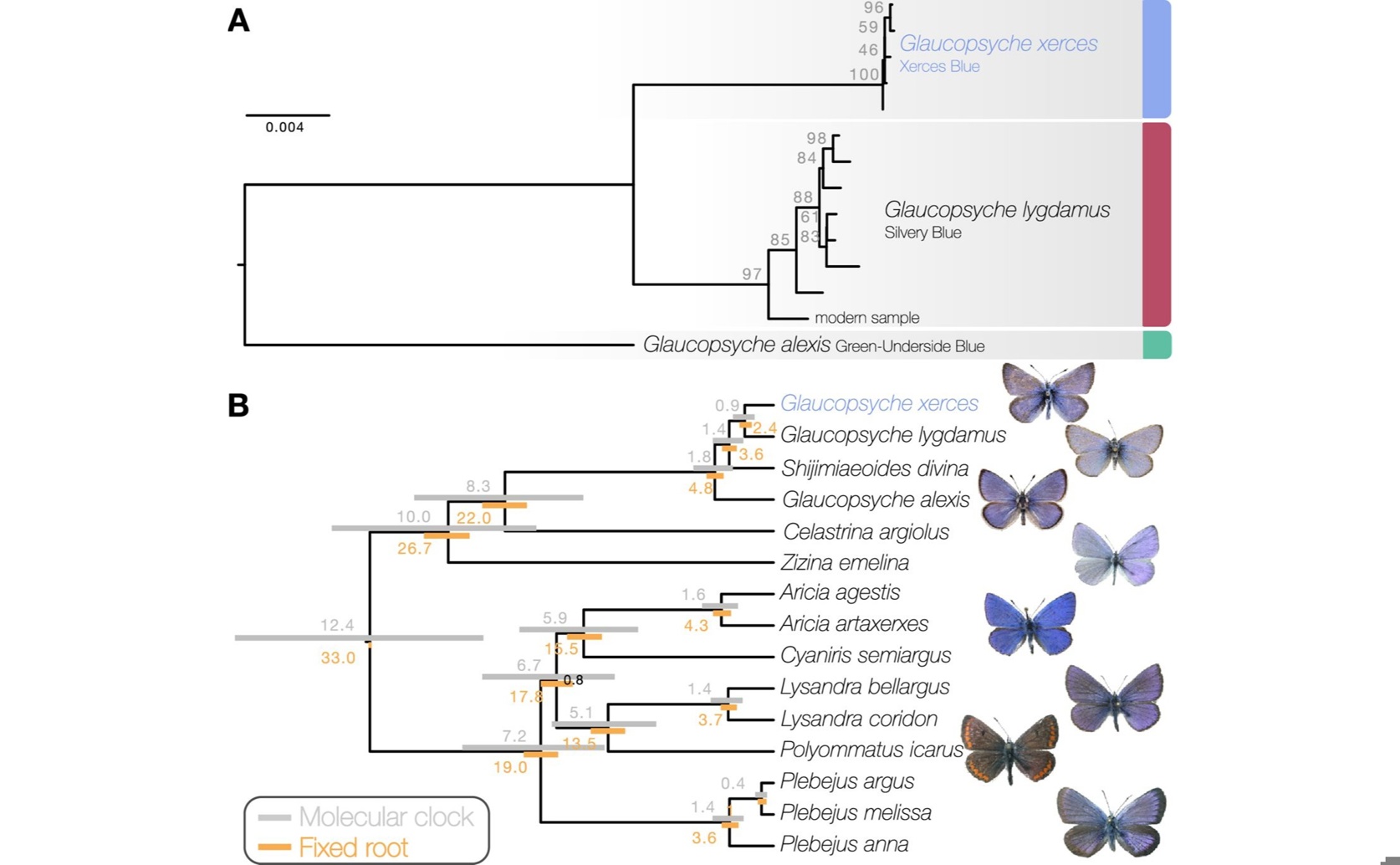
Phylogenetic analysis of mitochondrial DNA confirms that the extinct Xerces Blue (Glaucopsyche xerces) is a distinct species (a) that diverged from its closest relative, the Silvery Blue (Glaucopsyche lygdamus), approximately 900,000 years ago (b).

Image adapted from: de-Dios et al. / CC BY (Source)

Key Findings

  • The study confirmed that the Xerces Blue butterfly, last seen near San Francisco's Presidio, was a distinct species
  • Genetic analysis showed the Xerces Blue diverged from its closest relative, the Silvery Blue, about 850,000 years ago
  • The Xerces Blue experienced significant population decline and genetic inbreeding, contributing to its extinction
The extinction of the Xerces Blue butterfly (Glaucopsyche xerces) in the early 1940s marked a significant moment in conservation history, as it became the first butterfly species to be declared extinct in historical times. Its striking lavender wings adorned with white spots were last seen in the dunes near San Francisco's Presidio military base. Recent research conducted by the Institute of Evolutionary Biology in Barcelona has provided new insights into this species' extinction and its genetic distinctiveness[1]. The study sequenced the genomes of four Xerces Blue specimens aged between 80 and 100 years, along with seven historical and one modern specimen of its closest relative, the Silvery Blue (Glaucopsyche lygdamus). These were compared to a newly annotated genome of the Green-Underside Blue (Glaucopsyche alexis). The findings indicate that the Xerces Blue was indeed a distinct species, diverging from the Silvery Blue lineage approximately 850,000 years ago. This conclusion aligns with earlier research that questioned the Xerces Blue's classification, suggesting it might have been an isolated population of another species. However, the application of next-generation sequencing (NGS) and genome skimming strategies on a 93-year-old museum specimen had already demonstrated that the Xerces Blue was a unique species driven to extinction by human activities[2]. This new study reinforces those findings by providing a comprehensive phylogenetic analysis using complete mitochondrial genomes. The research also explored the population dynamics of these butterflies using nuclear genomes. Both the Xerces Blue and Silvery Blue experienced population growth during the Eemian interglacial period. However, the Xerces Blue's population size declined significantly afterward, contrasting with the Silvery Blue's continued growth. The study found higher runs of homozygosity and deleterious genetic load in the Xerces Blue, indicating a greater incidence of inbreeding and genetic decline. These observations are critical as they provide a genetic basis for understanding the species' vulnerability. The Xerces Blue's decline could serve as a model for identifying and monitoring other insect species threatened by human activities. This approach is particularly relevant given the potential of unlocking vast genomic data from natural history collections, which can offer unprecedented opportunities for evolutionary and phylogenetic studies[3]. The use of historical specimens in molecular studies has been challenging due to the degraded nature of DNA. However, modern NGS methods, designed for short fragmented DNA molecules, have changed the landscape. Previous studies have successfully generated genome-scale data from dry-preserved specimens up to 115 years old, highlighting the feasibility of such approaches for insects and other organisms[3]. This study's success in sequencing historical Xerces Blue specimens further exemplifies the potential of NGS in conservation genomics. Butterflies, with their extensive species diversity and ecological significance, have long been subjects of evolutionary and ecological research. A robust phylogenetic framework is essential for understanding their evolutionary history and informing conservation strategies[4]. This study contributes to that framework by clarifying the distinctiveness and historical population trends of the Xerces Blue, providing a genetic foundation for future conservation efforts. In summary, the research conducted by the Institute of Evolutionary Biology underscores the importance of genomic studies in conservation. By confirming the Xerces Blue as a distinct species and elucidating its genetic decline, the study not only resolves historical taxonomic ambiguities but also sets a precedent for using genomic data to protect other threatened insects. This work builds on previous findings and demonstrates the transformative potential of next-generation sequencing in understanding and mitigating biodiversity loss.

GeneticsAnimal ScienceEvolution

References

Main Study

1) Whole genomes from the extinct Xerces Blue butterfly can help identify declining insect species.

Published 4th October, 2024

https://doi.org/10.7554/eLife.87928


Related Studies

2) Museum genomics reveals the Xerces blue butterfly (Glaucopsyche xerces) was a distinct species driven to extinction.

https://doi.org/10.1098/rsbl.2021.0123


3) Genomic treasure troves: complete genome sequencing of herbarium and insect museum specimens.

https://doi.org/10.1371/journal.pone.0069189


4) A Comprehensive and Dated Phylogenomic Analysis of Butterflies.

https://doi.org/10.1016/j.cub.2018.01.061


Related Articles

An unhandled error has occurred. Reload 🗙