Understanding How Plant Pathogen DNA Binding Predicts Function and Evolution

Jim Crocker
24th July, 2024

Understanding How Plant Pathogen DNA Binding Predicts Function and Evolution

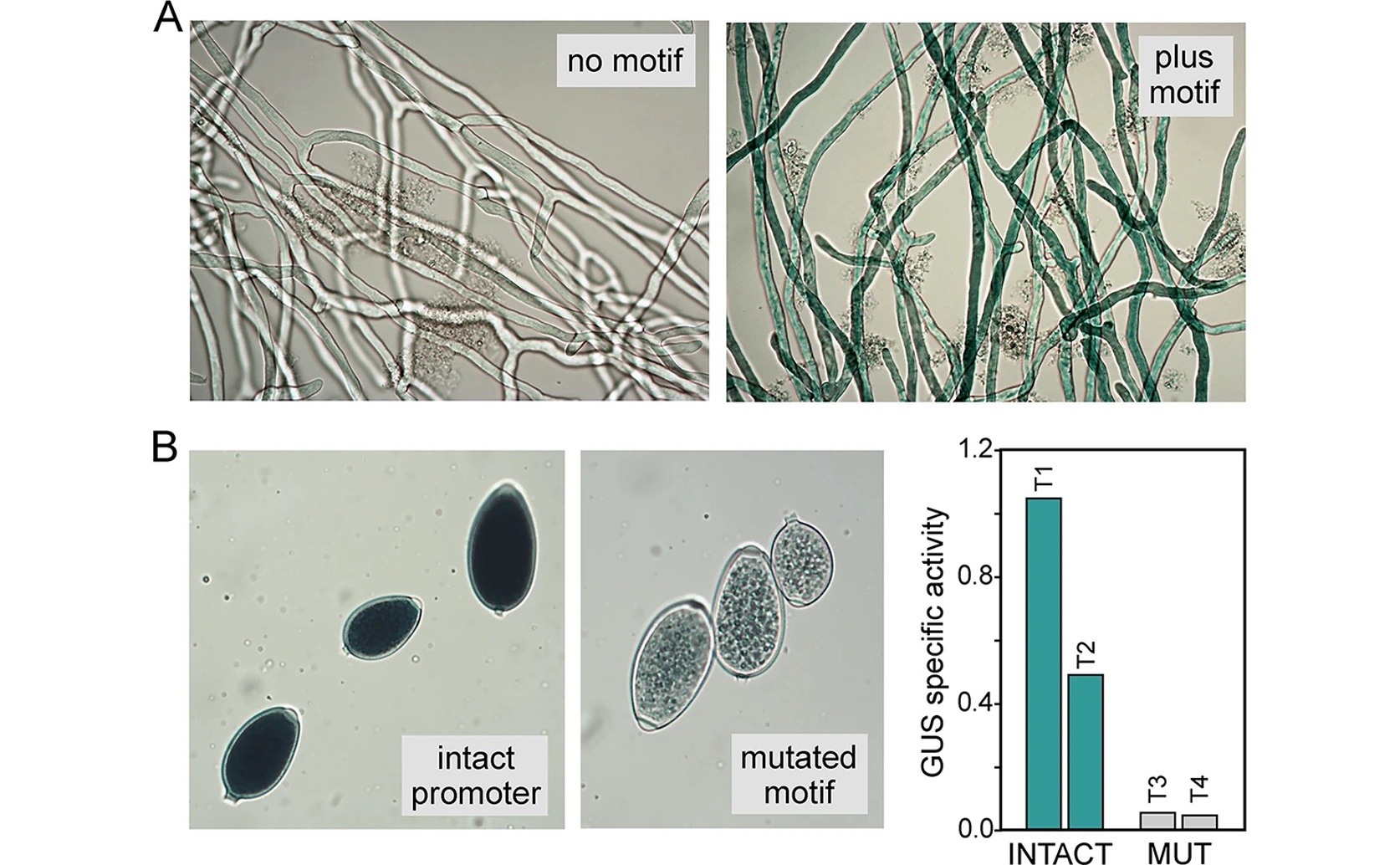
Experiments in Phytophthora infestans confirmed that the binding site for the HSF transcription factor PITG_04701 functions as a transcriptional activator, as it was sufficient to drive expression from a minimal promoter (a) and necessary for robust expression from a full promoter (b).

Image adapted from: Vo et al. / CC BY (Source)

Key Findings

  • Researchers at the University of California studied how transcription factors (TFs) bind to DNA in the plant pathogen Phytophthora infestans
  • They identified the DNA sequences that different TFs bind to, creating a comprehensive map of TF binding sites in the genome
  • The study found both conserved and unique DNA-binding specificities in Phytophthora infestans compared to other eukaryotes, highlighting evolutionary divergence
Understanding how transcription factors (TFs) bind to DNA is crucial for deciphering the gene networks that govern growth and development. This knowledge is particularly lacking in oomycetes, a group of microbial eukaryotes within the stramenopile lineage. Oomycetes include several significant plant and animal pathogens, such as Phytophthora infestans, which causes potato and tomato blight. Researchers at the University of California have conducted a study to identify the DNA-binding specificities of TFs in these organisms, using Phytophthora infestans as a model for life-stage differentiation within the group[1]. Transcription factors are proteins that bind to specific DNA sequences, thereby controlling the rate at which genetic information is transcribed from DNA to messenger RNA. This process is essential for regulating genes that control various biological functions. Previous studies have highlighted the importance of TFs in gene regulation across different organisms. For instance, the evolution of TF repertoires has been shown to play a significant role in the emergence of multicellular lineages in eukaryotes[2]. Additionally, variations in noncoding regulatory sequences, which include TF binding sites, have been linked to evolutionary changes[3]. The researchers at the University of California aimed to fill the gap in our understanding of TF binding specificities in oomycetes. This is particularly important because Phytophthora infestans serves as a model organism for studying life-stage differentiation, a critical aspect of the pathogen's lifecycle. By identifying the DNA-binding specificities of TFs in this organism, the researchers hoped to shed light on how gene regulation occurs in oomycetes and how it might differ from other eukaryotic lineages. To achieve this, the researchers employed a variety of experimental techniques to profile the DNA-binding specificities of TFs in Phytophthora infestans. They used high-throughput methods to systematically identify the DNA sequences that different TFs bind to. This approach allowed them to generate a comprehensive map of TF binding sites in the genome of Phytophthora infestans. The findings of this study revealed that the DNA-binding specificities of TFs in Phytophthora infestans show both conservation and divergence when compared to other eukaryotes. For example, some TFs in Phytophthora infestans have binding motifs that are similar to those found in other eukaryotes, suggesting a level of conservation. However, other TFs exhibit unique binding specificities, indicating divergence. This is consistent with earlier findings that showed extensive diversification in DNA-binding motifs among related species[4]. Moreover, the study found that variations in TF binding sites play a significant role in the regulation of gene expression in Phytophthora infestans. This aligns with previous research that demonstrated the importance of such variations in the evolution of TF binding sites between related species[3]. The researchers also noted that the diversification of TF binding specificities in Phytophthora infestans could be linked to the organism's ability to adapt to different environmental conditions and hosts. In summary, this study by the University of California provides valuable insights into the DNA-binding specificities of TFs in oomycetes, specifically Phytophthora infestans. By identifying the binding motifs of these TFs, the researchers have contributed to our understanding of gene regulation in this important group of microbial eukaryotes. Their findings also highlight the broader significance of TF binding specificities in the evolution and adaptation of eukaryotic organisms, building on previous research in the field[2][3][4].

GeneticsPlant ScienceEvolution

References

Main Study

1) Transcription factor binding specificities of the oomycete Phytophthora infestans reflect conserved and divergent evolutionary patterns and predict function

Published 23rd July, 2024

https://doi.org/10.1186/s12864-024-10630-6


Related Studies

2) Transcription factor evolution in eukaryotes and the assembly of the regulatory toolkit in multicellular lineages.

https://doi.org/10.1073/pnas.1311818110


3) Evolution of transcription factor binding through sequence variations and turnover of binding sites.

https://doi.org/10.1101/gr.276715.122


4) Similarity regression predicts evolution of transcription factor sequence specificity.

https://doi.org/10.1038/s41588-019-0411-1


Related Articles

An unhandled error has occurred. Reload 🗙