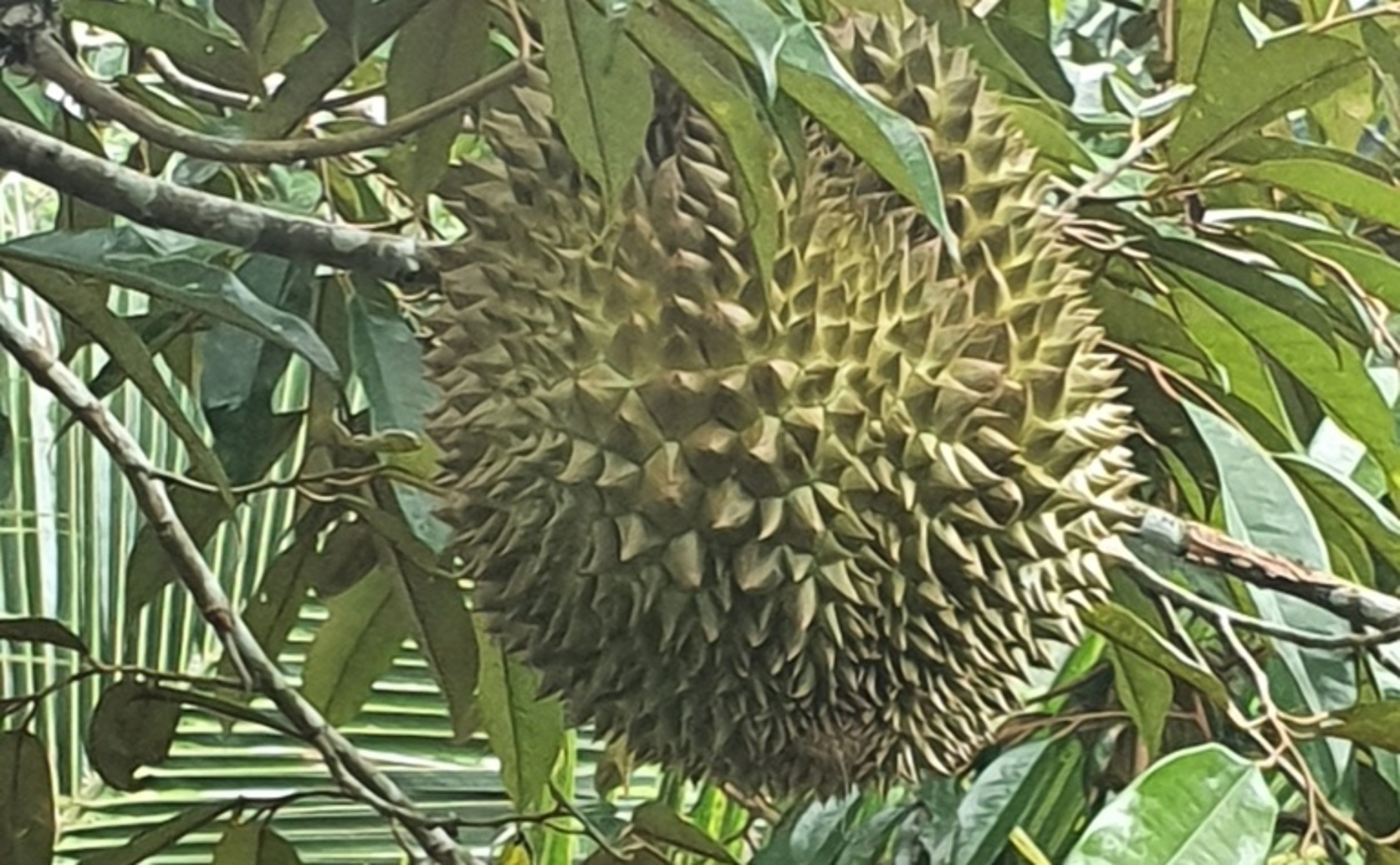
How Durian Fruit Gets Its Flavor: Key Activators and Repressors Explained

Jim Crocker
24th June, 2024

How Durian Fruit Gets Its Flavor: Key Activators and Repressors Explained

Durian (Durio zibethinus)

Photo adapted from: Jacek Pietruszewski / CC BY (Source)

Key Findings

  • Researchers at Chulalongkorn University studied the roles of MYB transcription factors in durian fruit
  • DzMYB2 activates, while DzMYB3 represses, the biosynthesis of phenolic compounds in durian
  • These findings could help develop durian varieties with better nutritional profiles and resistance to environmental stresses
Durian fruit, known for its unique aroma and rich nutritional profile, contains a variety of bioactive compounds, including phenolics, carotenoids, and vitamins. These compounds contribute to the fruit's health benefits and are regulated by complex biochemical pathways. A recent study by researchers at Chulalongkorn University has shed light on the roles of specific MYB transcription factors (TFs) in regulating the phenylpropanoid pathway, which is crucial for the biosynthesis of phenolic compounds in durian pulps[1]. Transcription factors are proteins that bind to specific DNA sequences, thereby controlling the transcription of genetic information from DNA to messenger RNA. In plants, MYB TFs are particularly important for regulating various metabolic pathways, including those involved in phenylpropanoid biosynthesis. This pathway not only contributes to the production of phenolic compounds but also plays a role in plant pigmentation, UV protection, and defense against pathogens. The study identified two key MYB TFs from the Monthong cultivar of durian: DzMYB2 and DzMYB3. DzMYB2 functions as an activator, while DzMYB3 acts as a repressor. These TFs were selected based on their expression patterns during different stages of fruit ripening. DzMYB2 was upregulated during the ripe stage, suggesting its role in enhancing phenolic content, whereas DzMYB3 was downregulated, indicating its repressive function. To understand the functions of these TFs, researchers conducted experiments using Nicotiana benthamiana leaves, a model plant system. Leaves expressing DzMYB2 showed increased phenolic compound contents compared to controls, while those expressing DzMYB3 exhibited decreased phenolic contents. This indicates that DzMYB2 promotes, and DzMYB3 represses, the biosynthesis of phenolic compounds in durian. Further analysis revealed that DzMYB2 and DzMYB3 regulate the promoters of various biosynthetic genes. DzMYB2 activates genes such as phenylalanine ammonia-lyase (PAL), chalcone synthase (CHS), chalcone isomerase (CHI), and dihydroflavonol reductase (DFR). Conversely, DzMYB3 represses the promoters of PAL, 4-coumaroyl-CoA ligase (4CL), CHS, and CHI. These genes are essential components of the phenylpropanoid pathway, and their regulation directly impacts the synthesis of phenolic compounds. Interestingly, the study also found that both DzMYB2 and DzMYB3 interact with another transcription factor, DzbHLH1, to regulate flavonoid biosynthesis. This interaction highlights the complexity of the regulatory network involved in phenolic compound production. The findings from this study align with previous research on MYB TFs in other plants. For instance, in strawberries, the MYB TF FaMYB1 has been shown to repress the biosynthesis of anthocyanins and flavonols, similar to the repressive function of DzMYB3 in durian[2]. In petunias, the MYB27 gene acts as a repressor of anthocyanin synthesis, functioning within a MYB-bHLH-WD repeat complex, which is analogous to the interaction between DzMYB2, DzMYB3, and DzbHLH1 in durian[3]. The study's insights into the regulatory roles of DzMYB2 and DzMYB3 enhance our understanding of the phenylpropanoid pathway in durian. This knowledge could have practical applications in agriculture and food science, such as developing durian varieties with enhanced nutritional profiles or improved resistance to environmental stresses. Moreover, the health benefits of phenolic compounds, particularly flavonoids, are well-documented. Flavonoids are known for their antioxidant properties, which can protect cells from damage caused by free radicals. They have been shown to reduce the risk of cardiovascular diseases, metabolic disorders, and certain types of cancer[4]. Understanding how these compounds are regulated in durian could lead to strategies for increasing their content in the fruit, potentially enhancing its health benefits. In conclusion, the study by Chulalongkorn University provides valuable insights into the roles of MYB transcription factors in regulating phenolic compound biosynthesis in durian. By identifying and characterizing DzMYB2 and DzMYB3, the researchers have contributed to our understanding of the complex regulatory networks that control important metabolic pathways in plants.

FruitsGeneticsBiochem

References

Main Study

1) Unveiling phenylpropanoid regulation: the role of DzMYB activator and repressor in durian (Durio zibethinus) fruit.

Published 24th June, 2024

https://doi.org/10.1007/s00299-024-03267-y


Related Studies

2) The strawberry FaMYB1 transcription factor suppresses anthocyanin and flavonol accumulation in transgenic tobacco.

Journal: The Plant journal : for cell and molecular biology, Issue: Vol 28, Issue 3, Nov 2001


3) A conserved network of transcriptional activators and repressors regulates anthocyanin pigmentation in eudicots.

https://doi.org/10.1105/tpc.113.122069


4) Overviews of Biological Importance of Quercetin: A Bioactive Flavonoid.

https://doi.org/10.4103/0973-7847.194044


Related Articles

An unhandled error has occurred. Reload 🗙