How viruses in the ocean change over time

Jenn Hoskins
16th November, 2025

How viruses in the ocean change over time

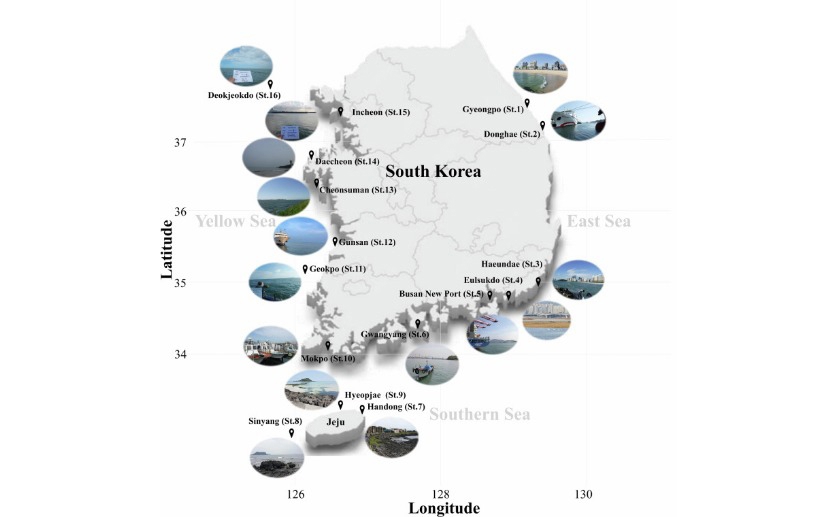
Map depicting the 16 sampling sites in the coastal waters of the Republic of Korea in 2021.

Image adapted from: Kim et al. / CC BY (Source)

Key Findings

  • Korean coastal waters harbor a remarkably diverse range of viruses, revealed by analyzing samples from 16 locations
  • Bacteriophages overwhelmingly dominate these viral communities (95%), indicating they strongly influence bacterial populations
  • Researchers created a publicly available dataset linking viral profiles to environmental conditions, aiding future marine research
Viruses are the most numerous life forms in the ocean, outnumbering bacteria[2]. These viruses, many of which infect bacteria (called bacteriophages), play a critical role in regulating marine ecosystems by controlling bacterial populations and influencing nutrient cycles. Understanding viral diversity is therefore crucial to understanding ocean health. However, most viral research has focused on the open ocean, leaving coastal areas relatively unexplored. Coastal regions are particularly important as they often experience greater human impact and are prone to algal blooms and pollution. Researchers at the Korea Institute of Ocean Science & Technology (KIOST) recently addressed this gap in knowledge[1]. They conducted a comprehensive study of viruses in Korean coastal waters, analyzing samples from 16 different locations. The study generated a large amount of genetic data – 265 gigabases – from 49 water samples, allowing for a detailed look at the viral communities present. This approach, known as metagenomics, involves sequencing all the genetic material in a sample, rather than focusing on individual known viruses. The analysis revealed a surprisingly diverse range of viruses. The vast majority – 95% – were bacteriophages, confirming earlier findings that phages are the dominant viruses in aquatic environments[3]. The remaining 5% were classified as nucleocytoplasmic large DNA viruses (NCLDVs), a group known for their large genomes and complex structures. Two viruses, Puniceispirillum phage HMO-2011 and Micromonas pusilla virus 12 T, were particularly abundant. The KIOST team didn’t just identify the viruses present; they also created a publicly available dataset including information about the environmental conditions at each sampling site – such as temperature and salinity – alongside the viral taxonomic profiles. This dataset is a valuable resource for other scientists, enabling comparative studies across different marine environments. This study builds upon previous work highlighting the importance of viruses in marine ecosystems[2][3]. Earlier research established that viruses are not simply agents of disease, but key players in regulating microbial communities and driving biogeochemical cycles. The sheer abundance of viruses, often exceeding that of bacteria, suggests a significant role in controlling bacterial populations and influencing the flow of energy and nutrients[2]. The KIOST study expands on this by providing a detailed snapshot of viral diversity in a coastal region, an environment often subject to significant environmental stress. The dominance of bacteriophages observed in this study aligns with the understanding that viruses primarily target bacteria in aquatic systems[3]. This predator-prey relationship between viruses and bacteria is a fundamental aspect of microbial ecology, influencing bacterial diversity and mortality rates. The identification of specific abundant phages, like Puniceispirillum phage HMO-2011, provides targets for future research aimed at understanding their specific roles in the coastal ecosystem. The inclusion of environmental data alongside the viral profiles is a significant strength of this study. This allows researchers to investigate potential links between environmental factors and viral community composition. For example, changes in temperature or salinity could influence the abundance of specific viruses or alter the overall viral diversity. This type of analysis is crucial for understanding how viruses respond to environmental change and how they might contribute to ecosystem resilience. The study also contributes to the growing field of ‘viral metagenomics’[2], which aims to uncover viral diversity using next-generation sequencing technologies. The researchers acknowledge the potential for biases in these techniques, highlighting the importance of careful data analysis and quality control. By providing a high-quality dataset and detailed metadata, the KIOST team has facilitated further research in this area.

GeneticsEcologyMarine Biology

References

Main Study

1) Dynamics of the DNA Viral Community in Korean Coastal Waters

Published 13th November, 2025

https://doi.org/10.1038/s41597-025-06062-w


Related Studies

2) Aquatic viral metagenomics: Lights and shadows.

https://doi.org/10.1016/j.virusres.2016.11.021


3) Ecology of prokaryotic viruses.

Journal: FEMS microbiology reviews, Issue: Vol 28, Issue 2, May 2004


Related Articles

An unhandled error has occurred. Reload 🗙