Two Tomato Enzymes Differ in Their Role in Plant Defense

Greg Howard
2nd October, 2025

Two Tomato Enzymes Differ in Their Role in Plant Defense

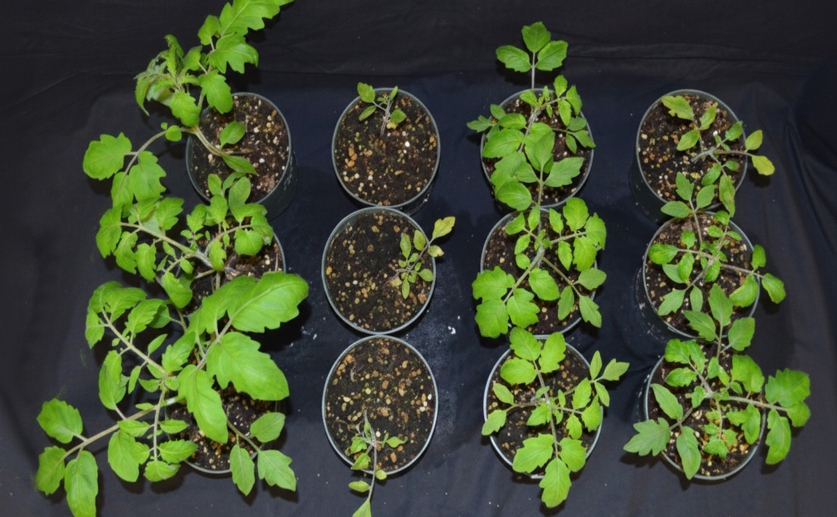
This photograph from the study (upscaled) shows seven week old tomato plants (Solanum lycopersicum) four weeks after gene silencing was initiated (SlUBA1 & SlUBA2). The leftmost plants are the control group, which had no genes silenced.

Image adapted from: Wang et al. / CC BY (Source)

Key Findings

  • Tomato plants have two E1 enzymes, SlUBA1 and SlUBA2, crucial for growth and immunity
  • Removing both SlUBA1 and SlUBA2 genes causes severe plant abnormalities and death, indicating some functional overlap but distinct roles
  • SlUBA2 is more important for defending tomato plants against the bacterial pathogen Pseudomonas syringae pv. tomato
Plants possess a complex system for regulating proteins, crucial for both their growth and defense against pathogens. This system relies heavily on a process called ubiquitination, where a small protein called ubiquitin is attached to other proteins, marking them for various fates – from degradation to altered function. The ubiquitination process isn’t a single step; it requires a cascade of enzymes, notably E1s, E2s, and E3s[2]. E1s, or ubiquitin-activating enzymes, are the first enzymes in this cascade, responsible for activating ubiquitin and preparing it for transfer to E2s, which then work with E3s to attach it to target proteins. While many plants have multiple E1 enzymes, their specific roles and whether they are interchangeable has been largely unknown. Researchers at the University of Nebraska-Lincoln recently investigated this question in tomato plants (Solanum lycopersicum)[1]. Their study focused on two E1 enzymes, SlUBA1 and SlUBA2, to understand their individual contributions to plant development and immunity. The team found that reducing the levels of either SlUBA1 or SlUBA2 individually caused different problems with plant growth. However, completely removing both genes led to severe abnormalities, stunted growth and eventual plant death. This suggests that while they have some overlapping functions, they are not fully redundant. A particularly striking finding was the difference in their roles in immunity. Silencing SlUBA2 significantly weakened the plant’s defense against the bacterial pathogen Pseudomonas syringae pv. tomato (Pst), while silencing SlUBA1 had little effect on immunity. This indicates that SlUBA2 plays a more critical role in defending against this specific pathogen. To understand how SlUBA1 and SlUBA2 differed in their function, the researchers examined their ability to ‘charge’ different E2 enzymes – essentially, to activate them with ubiquitin. They discovered that SlUBA1 and SlUBA2 were more efficient at charging different groups of E2 enzymes. Specifically, SlUBA2 was much better at activating E2s from groups IV, V, VI and XII. Further experiments revealed that the difference in charging efficiency stemmed from the C-terminal ubiquitin-folding domains (UFDs) of the enzymes. Swapping these domains between SlUBA1 and SlUBA2 reversed their E2-charging preferences. The researchers also identified a single amino acid residue in SlUBA2 (SlUBA2Q1009) and a 13-amino acid sequence unique to group V E2s that were important for proper E2 charging. Mutating the residue or deleting the sequence altered the charging profiles of both E1 enzymes. These findings support the idea that tomato plants utilize “dual ubiquitin-activating systems” (DUAS), where different E1 enzymes preferentially activate different sets of E2 enzymes, leading to distinct downstream effects. Interestingly, the study also found a parallel in Arabidopsis thaliana. The Arabidopsis E1 enzymes, AtUBA1 and AtUBA2, also differentially charge E2 enzymes homologous to the tomato group IV E2s. Given that group IV E2s have been linked to plant immunity[2], this suggests that the mechanism of distinct E1 enzyme function is conserved across plant species. This research builds on prior knowledge of the ubiquitination system, highlighting its complexity and the importance of understanding the specific roles of its components in regulating plant responses to both developmental cues and environmental stresses[2]. The SlUBA2-group IV E2 module is likely a key regulator of host defense in tomato.

VegetablesGeneticsPlant Science

References

Main Study

1) The Two Tomato Ubiquitin E1 Enzymes Play Unequal Roles in Host Immunity

Published 29th September, 2025

https://doi.org/10.1111/mpp.70160


Related Studies

2) The ubiquitination machinery of the ubiquitin system.

https://doi.org/10.1199/tab.0174


Related Articles

An unhandled error has occurred. Reload 🗙