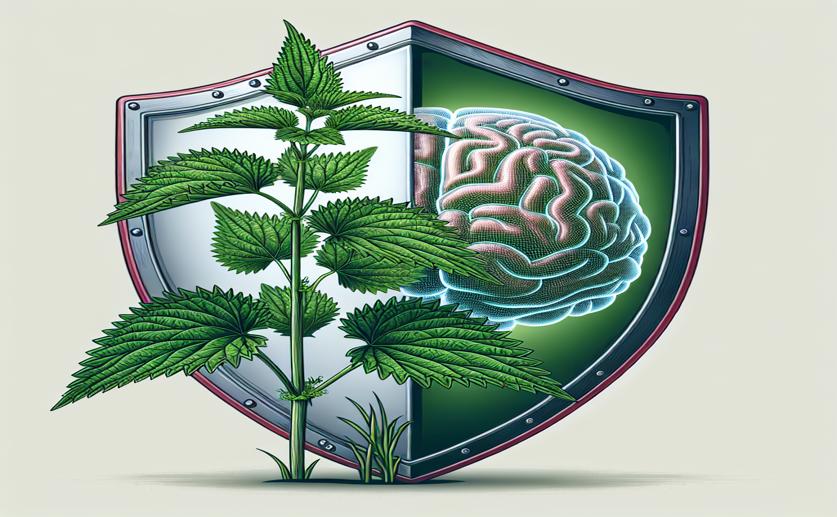
How Nettle Extract Shields Brain Damage from a Common Food Additive

David Palenski
8th February, 2024

How Nettle Extract Shields Brain Damage from a Common Food Additive

Slender stinging nettle (Urtica gracilis)

Photographer: Kari Moreland
Potassium bromate (KBrO3) is a chemical compound used in various industries, including food production – notably in cheese and beer making – and in pharmaceuticals and cosmetics. However, it’s also recognized as a potentially harmful substance, classified as a carcinogen due to its ability to create unstable molecules called free radicals within the body[2]. These free radicals can damage cells and contribute to the development of cancer. Concerns about KBrO3’s toxicity have led researchers to investigate ways to mitigate its negative effects. A recent study conducted at Zagazig University[1] investigated the impact of KBrO3 on the brain tissue of rats, specifically the cerebral cortex – the outer layer responsible for higher-level brain functions. The study also examined whether Urtica dioica (commonly known as stinging nettle), a plant with known anti-inflammatory and antioxidant properties, could offer protection against KBrO3-induced damage. The researchers divided thirty male rats into three groups. The first group served as a control, receiving no KBrO3 or Urtica dioica. The second group was exposed to KBrO3 alone, while the third group received both KBrO3 and Urtica dioica. After the experimental period, the rats were examined using both light and electron microscopy – powerful tools that allow scientists to visualize tissues at different levels of detail. They also used immunohistochemistry, a technique that uses antibodies to identify specific proteins within the tissue. The results showed that KBrO3 exposure caused significant damage to the nerve cells in the cerebral cortex. These cells exhibited distorted shapes, abnormal nuclei (the cell’s control center), and disruptions within their internal structures, such as the rough endoplasmic reticulum (RER) – involved in protein production – and mitochondria – the cell’s powerhouses. The spaces between nerve cells, known as the neuropil, also appeared damaged and filled with fluid. Furthermore, the study found increased activity of glial fibrillary acidic protein (GFAP) in cells called astrocytes, indicating a response to injury in the brain. These findings align with earlier research demonstrating the harmful effects of KBrO3 on various organs. For example, studies have shown that KBrO3 can reduce blood cell counts, disrupt lipid profiles (cholesterol levels), and impair kidney and liver function in mice[2][3]. These effects are thought to be linked to the oxidative stress caused by KBrO3, where an imbalance between free radical production and the body’s ability to neutralize them leads to cellular damage. However, the Zagazig University study revealed a promising protective effect of Urtica dioica. Rats that received both KBrO3 and Urtica dioica showed significantly less damage to their brain cells compared to those exposed to KBrO3 alone. The Urtica dioica appeared to restore the brain tissue to a condition very similar to the control group. This suggests that the plant’s antioxidant properties can counteract the damaging effects of KBrO3. This protective effect of Urtica dioica is consistent with previous research showing that taurine, another antioxidant compound, can also mitigate KBrO3-induced oxidative stress in blood[4]. Both Urtica dioica and taurine appear to work by neutralizing free radicals and reducing the overall level of oxidative damage. The study’s use of both light and electron microscopy provided a comprehensive view of the cellular damage caused by KBrO3 and the protective effects of Urtica dioica. The morphometric and statistical analyses added further rigor to the findings, confirming that the observed differences between the groups were statistically significant.

HerbsMedicineAnimal Science

References

Main Study

1) Protective effects of Urtica dioica on the cerebral cortex damage induced by Potassium bromate in adult male albino rats.

Published 3rd March, 2024 (future Journal edition)

https://doi.org/10.1080/01913123.2023.2287664


Related Studies

2) Deleterious effects of potassium bromate administration on renal and hepatic tissues of Swiss mice.

https://doi.org/10.1016/j.sjbs.2017.01.060


3) Potassium bromate content of selected bread samples in Ilorin, Central Nigeria and its effect on some enzymes of rat liver and kidney.

https://doi.org/10.1016/j.fct.2009.05.026


4) Protective effect of taurine against potassium bromate-induced hemoglobin oxidation, oxidative stress, and impairment of antioxidant defense system in blood.

https://doi.org/10.1002/tox.22045


Related Articles

An unhandled error has occurred. Reload 🗙