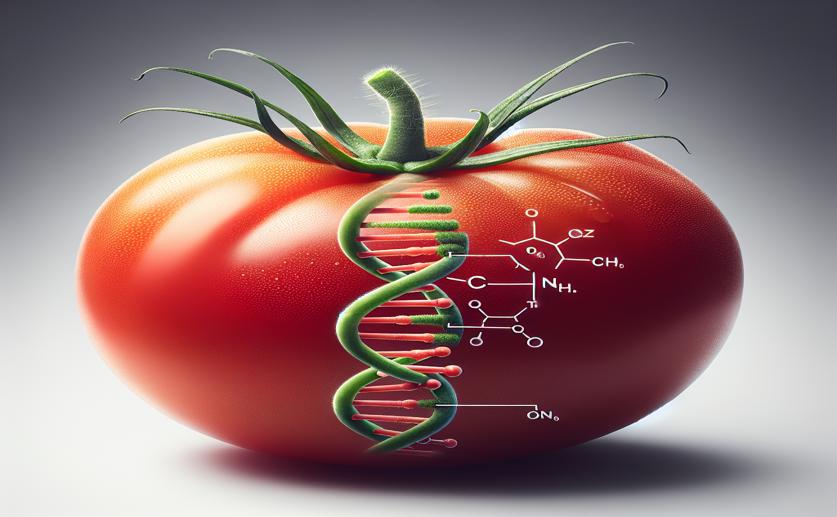
Exploring How a Key Gene Influences Tomato Ripening Using CRISPR.

Phil Stevens
24th January, 2024

Exploring How a Key Gene Influences Tomato Ripening Using CRISPR.

Tomato (Solanum lycopersicum)

Photo adapted from: Wutthichayapartith Rasvara Nangkasamarinile / CC BY (Source)
Tomato ripening is a complex process controlled by a network of genes. For decades, scientists believed the RIN gene was essential for initiating this process, but recent research has challenged that idea[2]. Understanding how ripening is regulated is important for improving fruit quality and extending shelf life. Researchers at Kyungpook National University have now used a precise gene-editing tool, CRISPR/Cas9, to further investigate the role of another key gene, TAGL1, in tomato ripening[1]. The study focused on TAGL1, a gene known to influence fruit pigmentation and ethylene production – ethylene being a crucial hormone for ripening. CRISPR/Cas9 technology allows scientists to make very specific changes to an organism’s DNA. In this case, the researchers aimed to ‘knock out’ or disable the TAGL1 gene in tomato plants, creating TAGL1-KO mutants. This involved introducing small changes to the gene’s sequence, resulting in a non-functional protein. The TAGL1-KO mutants displayed several noticeable differences compared to normal tomato plants (referred to as ‘wild type’). The fruits remained dark and immature for longer, and when they did ripen, they were orange rather than the typical red. They also developed a pointed shape and had thinner flesh (pericarp). Crucially, the TAGL1-KO fruits showed reduced ethylene production, remained firmer, and ripened more slowly. Measurements showed lower levels of chlorophyll in the early stages of fruit development, and reduced lycopene – the pigment responsible for red colour – during ripening. The researchers also examined the activity of several other genes known to be involved in ripening. They found that genes related to ethylene production (ACS2, ACS4, ACO1, ACO3), fruit softening (PG2a, PL, PME, EXP1), and pigment production (PSY1) were all less active in the TAGL1-KO mutants. This suggests that TAGL1 normally acts to promote the activity of these genes, driving the ripening process. Interestingly, the researchers also looked at what happened when they combined the TAGL1 knockout with a mutation in the RIN gene. Previous work had shown that RIN mutants also have ripening defects, but not a complete failure to ripen[2]. However, when TAGL1 was also knocked out in these rin mutants, the ripening defects were even more severe. This suggests that TAGL1 and RIN work together, and that disrupting both genes has a greater effect than disrupting either one alone. These findings build on earlier research that identified TAGL1 as a regulator of ripening, showing it can directly activate ACS2, a gene involved in ethylene production[3]. The current study strengthens this understanding by demonstrating that removing TAGL1 significantly disrupts the entire ripening process. It also adds nuance to the understanding of RIN’s role. While RIN was once thought to be essential for initiating ripening, it’s now understood to be more of a repressor of ripening when mutated[2]. The interaction between TAGL1 and RIN suggests a more complex regulatory network than previously appreciated. Furthermore, the study echoes findings from research on the nor mutant, which also exhibits altered ripening due to a mutated gene[4]. The nor mutant’s altered protein interferes with the activity of genes involved in ripening, similar to how the TAGL1-KO mutants show reduced activity of key ripening genes. Both studies highlight the importance of gene regulation in controlling the timing and progression of fruit ripening.

FruitsBiotechPlant Science

References

Main Study

1) Reassessing the contribution of TOMATO AGAMOUS-LIKE1 to fruit ripening by CRISPR/Cas9 mutagenesis.

Published 22nd January, 2024

https://doi.org/10.1007/s00299-023-03105-7


Related Studies

2) Re-evaluation of the rin mutation and the role of RIN in the induction of tomato ripening.

https://doi.org/10.1038/s41477-017-0041-5


3) TOMATO AGAMOUS-LIKE 1 is a component of the fruit ripening regulatory network.

https://doi.org/10.1111/j.1365-313X.2009.04064.x


4) Re-evaluation of the nor mutation and the role of the NAC-NOR transcription factor in tomato fruit ripening.

https://doi.org/10.1093/jxb/eraa131


Related Articles

An unhandled error has occurred. Reload 🗙