How Black Ginseng Fights Prostate Cancer Revealed by Science

Greg Howard
19th January, 2024

How Black Ginseng Fights Prostate Cancer Revealed by Science

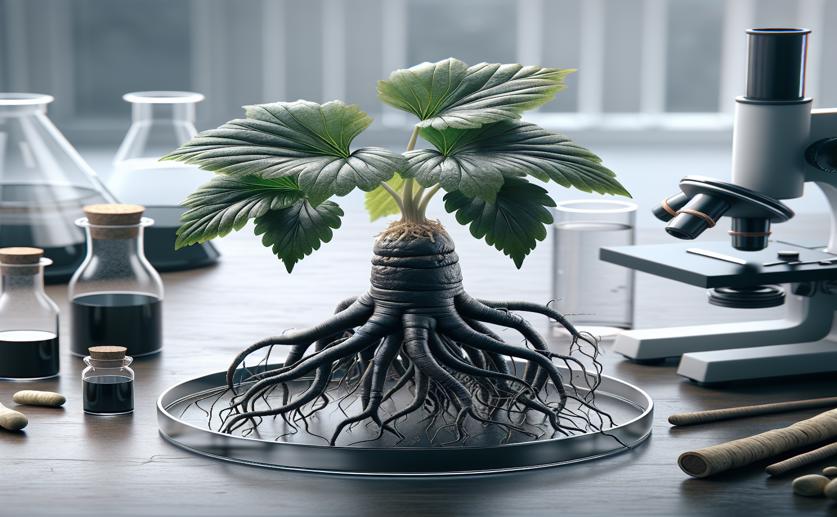
Photograph of an original Panax ginseng plant, which can undergo extensive processing to become Black ginseng.

Photo adapted from: Nina Filippova / CC BY (Source)
Prostate cancer is a significant health concern for men worldwide, and research into new treatment options is ongoing. Traditional Chinese Medicine (TCM), particularly ginseng, has a long history of use for various health conditions, including cancer[2]. However, understanding how ginseng and its components work at a molecular level is crucial for developing effective therapies. Recent research from Liaoning University of Traditional Chinese Medicine[1] investigates the anti-prostate cancer mechanisms of black ginseng, a processed form of ginseng, and how its effects change with different processing times. The study focused on identifying the specific compounds within black ginseng that contribute to its potential anti-cancer properties. Black ginseng is created through a repeated process of steaming and drying ginseng roots, which alters its chemical composition. Researchers used a technique called High-Performance Liquid Chromatography (HPLC) to identify and quantify 6 small-molecule organic acids, maltol, 5-hydroxymethylfurfural (5-HMF), 17 ginsenosides, 4 oligosaccharides, and 20 amino acids present in black ginseng samples processed for varying durations. “Ginsenosides” are naturally occurring compounds found in ginseng, considered to be the primary active ingredients responsible for its medicinal effects[3]. To determine which of these compounds were most affected by the processing, the researchers employed statistical analysis. They then used “network pharmacology” – a computational approach – to predict how these compounds might interact with biological targets within prostate cancer cells and which cellular pathways they might influence. This approach helps to understand the complex interactions between multiple compounds and their combined effect. Finally, they used a method called the entropy weight method to assign importance values to the identified ingredients, targets, and pathways, creating a “vector space network” to model the anti-prostate cancer mechanisms. The analysis revealed that fructose, glucose, dencichin, glutamate, and several ginsenosides – including 20(S)-Rg3, 20(R)-Rg3, 20(S)-Rh2, Rg1, Re, and Rc – were the most significantly altered compounds during the black ginseng processing. These findings build on previous research identifying around 40 different ginsenosides in ginseng, each with potentially unique mechanisms of action[3]. The study showed that the changing levels of these compounds during processing directly impacted black ginseng’s ability to combat prostate cancer. Specifically, the researchers found that the key to black ginseng’s changing anti-cancer effects was its influence on two major signaling pathways: the PI3K-Akt pathway and the chemical carcinogenesis-receptor activation pathway. Signaling pathways are essentially communication networks within cells that control various functions, including cell growth and survival. The PI3K-Akt pathway is often overactive in cancer cells, promoting their growth and preventing programmed cell death (apoptosis). By modulating this pathway, black ginseng could potentially inhibit cancer cell proliferation. The chemical carcinogenesis-receptor activation pathway relates to how cells respond to damaging chemicals, and influencing this pathway could reduce the risk of cancer development. Interestingly, the study highlights the importance of ginsenoside Rh2 (Rh2)[2], a major bioactive ginsenoside from Panax ginseng, and its potential role in the observed anti-cancer effects. While this study doesn’t focus solely on Rh2, its presence among the key ginsenosides identified suggests it could be a significant contributor. Furthermore, the increased cytotoxicity of black ginseng compared to red ginseng, linked to the presence of Rg5[4], suggests that the steaming and drying process enhances the potency of certain compounds. The research also connects to the understanding that ginsenoside compound K (CK) – a metabolite produced by gut bacteria from other ginsenosides – also exhibits anti-cancer properties[5]. While this study doesn’t directly investigate CK, the processing of black ginseng could potentially influence the formation of CK within the body, adding another layer to its anti-cancer mechanisms.

HerbsMedicineBiochem

References

Main Study

1) Anti-prostate cancer mechanism of black ginseng during the "nine steaming and nine sun-drying" process based on HPLC analysis combined with vector space network pharmacology.

Published 18th January, 2024

https://doi.org/10.1007/s12672-024-00862-z


Related Studies

2) Anticancer property of ginsenoside Rh2 from ginseng.

https://doi.org/10.1016/j.ejmech.2020.112627


3) A review on the medicinal potentials of ginseng and ginsenosides on cardiovascular diseases.

https://doi.org/10.1016/j.jgr.2014.03.001


4) Efficacy and safety evaluation of black ginseng (Panax ginseng C.A. Mey.) extract (CJ EnerG): broad spectrum cytotoxic activity in human cancer cell lines and 28-day repeated oral toxicity study in Sprague-Dawley rats.

https://doi.org/10.1186/s12906-022-03522-3


5) Anticancer properties and pharmaceutical applications of ginsenoside compound K: A review.

https://doi.org/10.1111/cbdd.13983


Related Articles

An unhandled error has occurred. Reload 🗙