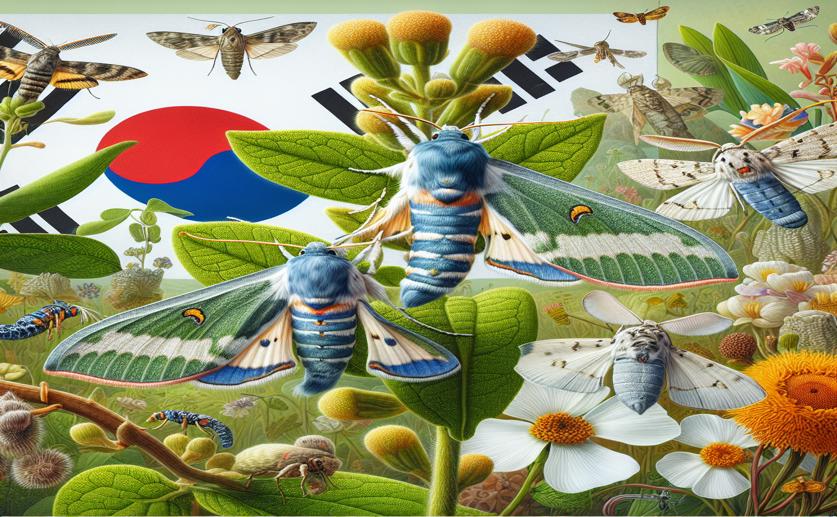
Discovering New Species: A Look at South Korea's Leaf-Mining Moths

David Palenski
5th January, 2024

Discovering New Species: A Look at South Korea's Leaf-Mining Moths
Photo adapted from: John Rosford / CC BY (Source)
Leaf-mining moths, a group of insects whose larvae feed inside plant leaves, are a diverse but often overlooked part of ecosystems. Understanding their diversity is crucial for comprehending plant health and broader ecological processes. Many species remain undiscovered or poorly documented, particularly in regions like Korea. These moths can also have economic impacts, as some are considered pests. Recent research from the National Science Museum of Korea[1] has significantly expanded our knowledge of these insects in the Korean peninsula. The study focused on the Phyllonorycter genus of leaf-mining moths, a group known for its close relationship with host plants and, in some cases, intriguing interactions with bacteria[2]. Researchers identified and cataloged 30 Phyllonorycter species found in Korea. This work isn’t simply a list; it includes the description of two entirely new species – Phyllonorycter phallustenuis and Phyllonorycter daehana – and the first official record of nine other species within the country. The process involved detailed examination of adult moths and their genitalia. Genitalia are frequently used in insect identification because they often exhibit species-specific characteristics. The researchers provided detailed descriptions and illustrations to aid in accurate identification. This is important because accurately identifying species is the first step towards understanding their roles in the environment. This research builds upon earlier findings regarding the complex relationships between leaf-mining moths, their host plants, and internal bacterial symbionts, particularly Wolbachia[2]. Some leaf miners can even alter the physiology of their host plants to create favorable feeding conditions, such as inducing “green islands” on leaves that would otherwise be turning color in autumn. While the Korean study doesn’t directly investigate these interactions, it provides a more complete picture of the Phyllonorycter species present, which is essential for future research into these phenomena. The discovery of new and previously unrecorded species in Korea highlights the importance of biodiversity surveys, even in relatively well-studied areas. The Korean peninsula shares some faunal similarities with regions like Japan[3], and the identification of species previously known from Japan or the Russian Far East reinforces these connections. The study also adds to a growing body of knowledge about the distribution of these moths, which is becoming increasingly important given the potential for some species to become invasive. Notably, the Russian Far East has also been the subject of recent Gracillariidae (leafminer moths) research[3], revealing a high level of biodiversity and several species new to science. The Korean study complements this work by expanding our understanding of the regional distribution of these moths and identifying potential areas for further investigation. The discovery of Phyllonorycter issikii in the Russian Far East[4] is particularly relevant, as this species is known to be invasive in parts of Europe and Russia, and understanding its genetic diversity and origins is crucial for managing its spread. The Korean study, by documenting the presence of other Phyllonorycter species, provides a baseline for monitoring potential future invasions or range shifts.

EnvironmentWildlifeBiotech

References

Main Study

1) The checklist of leaf-mining moths Phyllonorycter Hbner (Lepidoptera: Gracillariidae) of Korea with description of two new species and nine newly recorded species.

Published 5th January, 2024

https://doi.org/10.11646/zootaxa.5397.3.5


Related Studies

2) Correlation between the green-island phenotype and Wolbachia infections during the evolutionary diversification of Gracillariidae leaf-mining moths.

https://doi.org/10.1002/ece3.1580


3) Exploring species diversity and host plant associations of leaf-mining micromoths (Lepidoptera: Gracillariidae) in the Russian Far East using DNA barcoding.

https://doi.org/10.11646/zootaxa.4652.1.1


4) From east to west across the Palearctic: Phylogeography of the invasive lime leaf miner Phyllonorycter issikii (Lepidoptera: Gracillariidae) and discovery of a putative new cryptic species in East Asia.

https://doi.org/10.1371/journal.pone.0171104


Related Articles

An unhandled error has occurred. Reload 🗙