How Whales and Krill Gather Spotted by Ocean Mapping

Greg Howard
28th February, 2024

How Whales and Krill Gather Spotted by Ocean Mapping

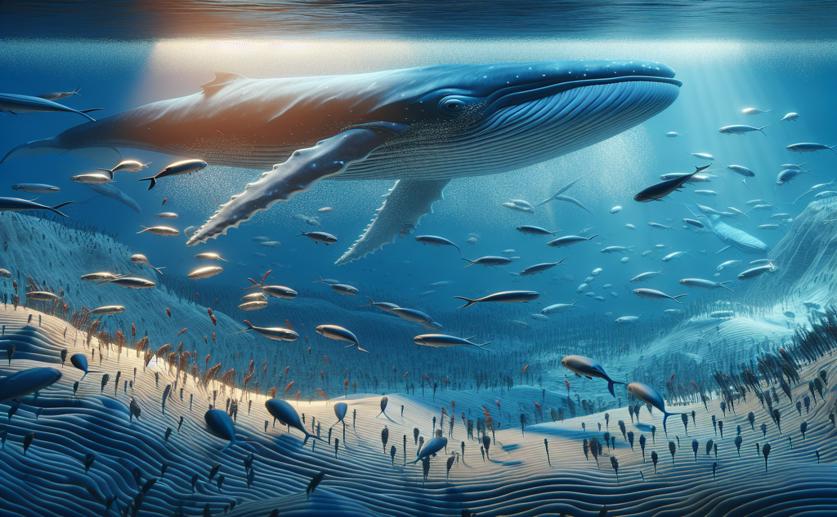
Blue Whale (Balaenoptera musculus)

Photo adapted from: Dan Vickers / CC BY (Source)
Understanding where marine animals find food is a fundamental challenge in marine biology. This is particularly true for large whales, which feed on tiny organisms like krill, and move across vast ocean areas. Identifying the oceanographic features that concentrate prey, and therefore attract whales, is crucial for conservation efforts, especially as ocean conditions change. A recent study by researchers at Stanford University[1] investigated how small-scale ocean currents influence the distribution of krill and baleen whales in the California Current System. The study focused on ‘submesoscale’ features – relatively small ocean currents less than 100 kilometers across. These currents are difficult to study directly, but can be identified using satellite data by tracking the movement of water masses over time. The researchers used a technique called ‘Lagrangian Coherent Structures’ (LCS) to map these currents, essentially highlighting areas where water tends to converge and accumulate. Simultaneously, they conducted ship-based surveys to measure krill density and record the presence of baleen whales. The findings revealed a strong link between these currents and biological activity. Areas where LCS converged – meaning water was accumulating – had significantly higher krill densities, up to 2.6 times greater than areas without these features. Crucially, baleen whales were also much more likely to be found in these areas, with a probability of presence up to 8.3 times higher. Furthermore, the study found that these current features were associated with denser seawater at depths up to 10 meters, suggesting they also influence nutrient distribution. This research builds on previous work highlighting the importance of prey patchiness in predator-prey relationships[2]. Earlier studies showed that marine predators don’t necessarily focus on areas of overall high prey biomass, but rather on specific, concentrated patches of prey. The Stanford study demonstrates that submesoscale currents may be a key mechanism creating these patches. It suggests that these currents aren’t just passively transporting krill, but actively concentrating them, making them attractive foraging grounds for whales. Interestingly, this aligns with observations made studying blue whale foraging behavior[3]. That research showed that whales adjust their feeding strategies based on prey density, becoming more efficient at capturing food when prey is abundant. The Stanford study provides a potential explanation for where these high-density patches form in the first place – at the convergence zones created by submesoscale currents. The energetic demands of feeding also play a role. Rorqual whales, like humpbacks, expend significant energy during lunge feeding – a method of rapidly engulfing large volumes of water to capture krill[4]. This high energy cost necessitates efficient foraging, and concentrating prey through currents would reduce the energy expenditure required to find sufficient food. The study’s findings have practical implications. Understanding the relationship between ocean currents, krill, and whales can inform strategies to reduce ship strikes, a major threat to whale populations. By predicting where whales are likely to concentrate, ships can adjust routes to avoid these areas. Additionally, this research can help assess how climate change, which is altering ocean currents, might impact this critical ecosystem. Changes to these submesoscale features could disrupt the food web, affecting both krill populations and the whales that depend on them.

EcologyOceanographyMarine Biology

References

Main Study

1) Submesoscale coupling of krill and whales revealed by aggregative Lagrangian coherent structures.

Published 28th February, 2024

https://doi.org/10.1098/rspb.2023.2461


Related Studies

2) Prey patch patterns predict habitat use by top marine predators with diverse foraging strategies.

https://doi.org/10.1371/journal.pone.0053348


3) Blue whales (Balaenoptera musculus) optimize foraging efficiency by balancing oxygen use and energy gain as a function of prey density.

https://doi.org/10.1126/sciadv.1500469


4) Foraging behavior of humpback whales: kinematic and respiratory patterns suggest a high cost for a lunge.

https://doi.org/10.1242/jeb.023366


Related Articles

An unhandled error has occurred. Reload 🗙