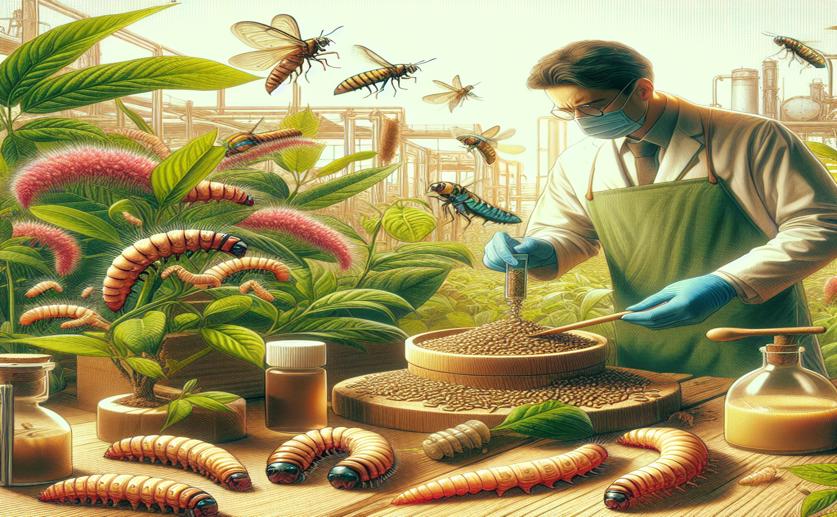
Exploring the Plant Extract's Safety and Components Against Pest Larvae

Jim Crocker
9th February, 2024

Exploring the Plant Extract's Safety and Components Against Pest Larvae

Mexican sunflower (Tithonia diversifolia)

Photo adapted from: Daniel Pineda Vera / CC BY (Source)
Fall armyworm (FAW), a destructive pest impacting maize crops, particularly in Africa, poses a significant threat to food security. Initial responses to FAW infestations often rely on chemical pesticides, but these can have negative health consequences and contribute to pesticide resistance[2]. This has driven research into alternative, safer pest control methods, specifically those utilizing plants with natural pesticidal properties. Researchers at Olusegun Agagu University of Science and Technology[1] investigated the potential of Tithonia diversifolia leaf extract as a biopesticide against FAW. The study focused on analyzing the chemical composition of the Tithonia diversifolia extract and assessing its toxicity to FAW larvae at different developmental stages. The researchers used Gas Chromatography-Mass Spectrometry (GC-MS) and Fourier-Transform Infrared Spectroscopy (FTIR) to identify the compounds present in the extract. GC-MS revealed 20 compounds, with beta-d-glucopyranoside, methyl, palmitic acid, and hexadecanoic acid being the most abundant. FTIR analysis indicated the presence of various functional groups including alcohols, phenols, aldehydes, ketones, alkanes, and primary amines. These compounds are believed to contribute to the plant’s pesticidal properties. The toxicity of both the crude extract and a butanol eluent (a solution obtained after extracting compounds with butanol) was tested on FAW larvae. A dose-dependent toxicity assay was conducted, meaning different concentrations of the extract were used to see how the level of exposure affected mortality rates. The results showed that both the butanol eluent and the crude extract were highly effective, causing 96% mortality in neonate (newly hatched) and first instar (early stage) FAW larvae. Further experiments were conducted under controlled phytotron conditions – a simulated environment – and compared the Tithonia diversifolia extract to azadirachtin, a known biopesticide derived from neem. These findings align with previous research highlighting the potential of plant-based solutions for FAW control[2]. The use of pesticidal plants is seen as a sustainable approach, particularly for smallholder farmers in Africa. The study builds on earlier work identifying natural enemies of FAW in Nigeria, such as parasitoid wasps and predatory mites[3], by offering another avenue for integrated pest management. While natural enemies offer ongoing control, plant extracts can provide a rapid response to outbreaks. The identification of specific compounds within the Tithonia diversifolia extract is significant. Similar investigations into Eucalyptus globulus essential oil identified 1,8-cineol and α-pinene as major compounds responsible for larvicidal activity against mosquitoes[4], demonstrating how identifying key chemical constituents can aid in biopesticide development. The Tithonia diversifolia extract’s effectiveness against early larval stages is particularly important, as these are the most vulnerable and susceptible to control measures. Interestingly, research on saponins from Tithonia diversifolia has shown effects on rat physiology, including reductions in cholesterol and triglycerides[5]. While this study doesn’t directly relate to FAW control, it suggests that Tithonia diversifolia possesses a range of bioactive compounds with potential benefits beyond pest management. The research at Olusegun Agagu University of Science and Technology concludes that the butanol eluent of Tithonia diversifolia leaf extract shows promise as an effective biopesticide for FAW, offering a potentially safer and more sustainable alternative to synthetic chemical pesticides.

AgricultureBiochemPlant Science

References

Main Study

1) Phytochemical characterisation and toxicity effect of Tithonia diversifolia (Hemls.) A. Gray leaf extract on fall army worm Spodoptera frugiperda (JE Smith) larvae.

Published 9th February, 2024

https://doi.org/10.1515/jcim-2023-0310


Related Studies

2) Bioactivity of Common Pesticidal Plants on Fall Armyworm Larvae (Spodoptera frugiperda).

https://doi.org/10.3390/plants9010112


3) Occurrence of natural enemies of fall armyworm, Spodoptera frugiperda (Lepidoptera: Noctuidae) in Nigeria.

https://doi.org/10.1371/journal.pone.0254328


4) Comparative efficacy of Eucalyptus globulus (Labill) hydrodistilled essential oil and temephos as mosquito larvicide.

https://doi.org/10.1080/14786419.2018.1547290


5) Tithonia diversifolia saponin-blood lipid interaction and its influence on immune system of normal wistar rats.

https://doi.org/10.1016/j.biopha.2017.01.017


Related Articles

An unhandled error has occurred. Reload 🗙