How Flaxseed Cake in Diet Affects Chicken Egg Quality and Nutrition

Jim Crocker
18th January, 2024

How Flaxseed Cake in Diet Affects Chicken Egg Quality and Nutrition
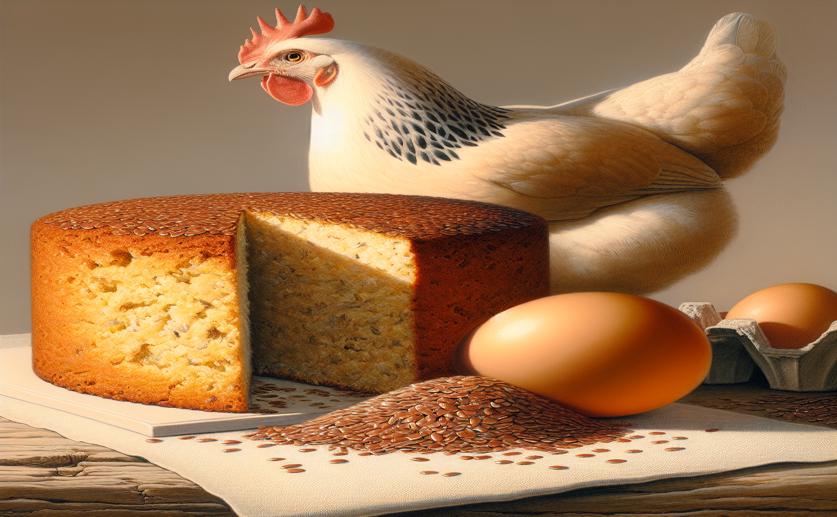
Photograph of flaxseed
Global food security faces increasing challenges, including shortages in animal feed. Finding sustainable and cost-effective feed sources is therefore crucial. Agro-industrial by-products, materials left over from processing crops, offer a potential solution. One such by-product is flaxseed cake (FSC), created after oil is extracted from flaxseed. FSC is rich in n-3 α-linolenic acid (ALA), an essential fatty acid with health benefits. A study conducted by researchers at King Abdulaziz University[1] investigated whether FSC could be used as a viable ingredient in the diets of laying hens without negatively impacting their performance or egg quality. The study involved dividing hens into three groups, each receiving a diet with 0%, 5%, or 10% FSC. The researchers monitored laying rate (how many eggs were laid), egg mass (total weight of eggs produced), and feed utilization (how efficiently the hens converted feed into eggs) over a ten-week period, from 48 to 58 weeks of age. They also assessed egg quality characteristics, sensory attributes (taste and appearance), and levels of essential trace elements – selenium (Se), zinc (Zn), and iron (Fe) – in both the hens’ blood (serum) and the eggs themselves. The findings indicated that incorporating up to 10% FSC into the hens’ diet did not harm their laying performance. Laying rate, egg mass, and feed utilization remained consistent across all groups. This is significant because it demonstrates that FSC can replace a portion of traditional feed ingredients without reducing egg production. Furthermore, the study revealed that FSC is a nutritionally valuable feedstuff, providing a good source of protein, energy, essential amino acids, and important minerals like calcium and phosphorus. Arginine, an amino acid crucial for growth and immune function, was particularly abundant in the FSC. These results align with earlier research demonstrating the benefits of flaxseed in poultry diets[2]. That study, also focused on flaxseed, found that it increased total n-3 fatty acid content in eggs, although the form of flaxseed (whole or ground) influenced the degree of deposition. The current study builds on this by examining flaxseed cake, a different form of the by-product, and assessing a broader range of nutritional parameters. Importantly, the inclusion of FSC did not negatively affect egg quality. Characteristics like shell strength, yolk color, and albumen (egg white) quality remained unaffected. Sensory evaluations also showed no discernible differences between eggs from hens fed diets with or without FSC. The study also examined the hens’ health, measuring levels of total protein and indicators of kidney function in their blood. Again, no adverse effects were observed with either 5% or 10% FSC inclusion. The researchers also investigated whether FSC influenced the levels of trace elements (Se, Zn, and Fe) in the hens’ serum and eggs. No significant differences were found between the groups, suggesting that FSC provides a balanced nutrient profile that doesn’t disrupt mineral metabolism. This is particularly relevant given the importance of these trace elements for both hen health and egg nutritional value.[3] highlighted the importance of adequate trace element levels in poultry diets for maintaining immune function and overall health. The study’s conclusion is that FSC is a valuable and sustainable feed ingredient for laying hens. Its balanced nutritional composition allows for inclusion at levels up to 10% of the diet without compromising laying performance, egg quality, or hen health. This finding offers a practical solution to the challenge of sourcing affordable and nutritious feed, while also utilizing an agricultural by-product that would otherwise go to waste. The research expands on previous work[4] which showed that diets high in ω-3 fatty acids, like those found in flaxseed, can contribute to healthier food products for consumers.

AgricultureNutritionHealth

References

Main Study

1) Dietary flaxseed cake influences on performance, quality, and sensory attributes of eggs, serum, and egg trace minerals of laying hens.

Published 18th January, 2024

https://doi.org/10.1007/s11250-024-03897-0


Related Studies

2) Yolk thiobarbituric acid reactive substances and n-3 fatty acids in response to whole and ground flaxseed.

Journal: Poultry science, Issue: Vol 74, Issue 8, Aug 1995


3) The impact of incorporation of n-3 fatty acids into eggs on ovarian follicular development, immune response, antioxidative status and tibial bone characteristics in aged laying hens.

https://doi.org/10.1017/S1751731111000619


4) Omega-3 enriched egg production: the effect of α -linolenic ω -3 fatty acid sources on laying hen performance and yolk lipid content and fatty acid composition.

https://doi.org/10.1080/00071668.2011.638621


Related Articles

An unhandled error has occurred. Reload 🗙