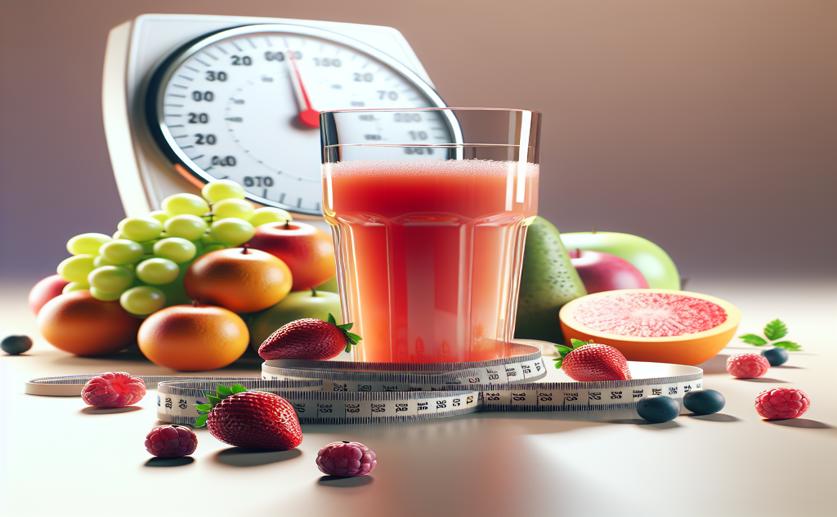
Does Drinking Pure Fruit Juice Affect Your Weight? A Comprehensive Study.

David Palenski
16th January, 2024

Does Drinking Pure Fruit Juice Affect Your Weight? A Comprehensive Study.
Growing concerns exist regarding the impact of frequent fruit juice consumption on weight gain, despite its perception as a healthy beverage. Previous research has highlighted that beverages, unlike solid foods, don’t trigger the same feeling of fullness, potentially leading to increased overall calorie intake[2]. This is because liquid calories don’t elicit the same compensatory dietary response as solid calories, meaning people don’t naturally reduce intake of other foods to account for the calories consumed in liquid form. A recent systematic review and meta-analysis conducted by researchers at the University of Toronto[1] aimed to clarify the relationship between 100% fruit juice intake and body weight changes in both children and adults. The study involved a comprehensive review of 42 eligible studies – 17 focusing on children and 25 on adults – published up to May 2023. These studies included both prospective cohort studies, which follow groups of people over time, and randomized controlled trials (RCTs), considered the gold standard for medical research. The researchers specifically looked for studies that examined changes in body mass index (BMI) in children (BMI is a measure of body fat based on height and weight) and changes in body weight in adults. To ensure a fair comparison, RCTs compared fruit juice consumption to non-caloric alternatives. The analysis revealed a concerning trend in children. Each additional daily serving of 100% fruit juice was associated with a 0.03 unit increase in BMI. While this may seem small, even modest increases in BMI over time can contribute to significant weight gain and increased risk of health problems. In adults, the findings were more nuanced. Studies that didn’t account for total energy intake showed a greater weight gain associated with fruit juice consumption (0.21 kg), while those that did adjust for energy intake showed a slight weight loss (-0.08 kg). This suggests that the weight gain observed in the unadjusted studies may be due to the extra calories provided by the fruit juice itself. The RCTs in adults showed no statistically significant association between fruit juice consumption and weight change, however, the confidence interval was quite wide, meaning the results were uncertain. This uncertainty highlights the need for more robust research in this area. It’s important to understand that a confidence interval indicates the range within which the true effect likely lies; a wide interval suggests a lack of precision in the estimate. These findings build upon earlier work demonstrating that fructose, a sugar abundant in fruit juice, is metabolized differently than glucose[3]. High-fructose corn syrup, commonly used in sweetened beverages, contains a higher proportion of fructose than glucose, and research suggests that this imbalance can contribute to metabolic issues. While the Toronto study focused on 100% fruit juice, the principles of fructose metabolism remain relevant. The study also supports the idea that simply consuming calories in liquid form can lead to weight gain, as demonstrated in studies comparing the effects of liquid versus solid carbohydrate intake[2]. The researchers concluded that limiting fruit juice consumption is a sensible strategy for preventing excess calorie intake and potential weight gain, particularly in children. The study underscores the importance of considering the overall dietary context when evaluating the health effects of specific foods and beverages.

FruitsNutritionHealth

References

Main Study

1) Consumption of 100% Fruit Juice and Body Weight in Children and Adults: A Systematic Review and Meta-Analysis.

Published 16th January, 2024

https://doi.org/10.1001/jamapediatrics.2023.6124


Related Studies

2) Liquid versus solid carbohydrate: effects on food intake and body weight.

Journal: International journal of obesity and related metabolic disorders : journal of the International Association for the Study of Obesity, Issue: Vol 24, Issue 6, Jun 2000


3) Fructose content in popular beverages made with and without high-fructose corn syrup.

https://doi.org/10.1016/j.nut.2014.04.003


Related Articles

An unhandled error has occurred. Reload 🗙