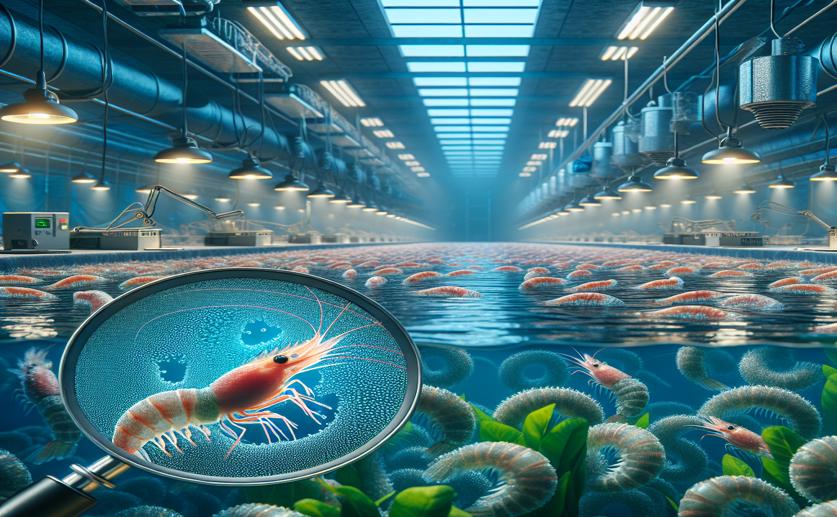
Exploring the Gut Bacteria of Farmed Shrimp in Indoor Facilities

Jim Crocker
22nd February, 2024

Exploring the Gut Bacteria of Farmed Shrimp in Indoor Facilities

Whiteleg Shrimp (Penaeus vannamei)

Photo adapted from: Diogo Luiz / CC BY (Source)
The health of farmed shrimp is a significant concern for the aquaculture industry. Shrimp are susceptible to diseases that can rapidly spread in the crowded conditions of commercial farms, leading to economic losses and impacting food security. A key factor influencing shrimp health is the community of bacteria living in their gut, known as the gut microbiota. This community plays a vital role in digestion, immunity, and overall well-being[2]. Understanding how environmental factors and the shrimp’s life stage affect this gut microbiota is crucial for developing strategies to improve shrimp health and reduce reliance on antibiotics. Researchers at the Chinese Academy of Fishery Sciences[1] recently investigated the bacterial composition within the guts of Litopenaeus vannamei shrimp, commonly known as white shrimp, and in the water they were raised in. The study considered several factors: the shrimp’s developmental stage (juvenile versus adult), health status (healthy versus diseased), water temperature (25°C and 28°C), and light intensity (low and high). The goal was to identify conditions that promote a healthy gut microbiota and improve shrimp resilience to disease. The study found a clear difference between the bacterial communities in the shrimp’s gut and those in the surrounding water. Analysis showed that the gut microbiota was far more diverse than the bacteria present in the water, suggesting the gut acts as a distinct environment for bacterial life. This supports the idea that the gut microbiota isn’t simply a reflection of the surrounding environment, but a complex community shaped by the shrimp itself and its internal conditions[3]. Specific bacterial groups were found to be more abundant under certain conditions. For example, the bacteria Vibrionaceae were more common in the guts of adult shrimp, healthy adults, shrimp raised at 28°C, and juveniles exposed to high light intensity. Conversely, Pseudoaltromonadaceae bacteria were more prevalent in juvenile shrimp, infected adults, juveniles with low light exposure, and adults kept at 25°C. The ratio between Firmicutes and Bacteroidota – two major groups of bacteria – also varied depending on the shrimp’s age, health, and environmental conditions. Importantly, the study revealed that juvenile shrimp appear to be more vulnerable to bacterial infections than adults. This is likely due to a less stable or less diverse gut microbiota in younger shrimp, making them more susceptible to disruption by harmful bacteria. This finding aligns with the broader understanding that gut microbiota development is crucial for establishing immune function in many organisms[2]. The researchers also identified specific environmental conditions that appear to promote a healthier gut microbiota. A water temperature of 28°C and high light intensity were both associated with beneficial bacterial compositions. These conditions could potentially be optimized in indoor shrimp farming systems to improve gut health and reduce the risk of disease. These findings build upon previous research highlighting the importance of the gut microbiota in aquatic organisms[2][3]. The study demonstrates that environmental factors can significantly influence the composition of the gut microbiota, and that these changes can impact the shrimp’s health. The observed plasticity of the shrimp gut microbiota, its ability to change in response to environmental shifts, is consistent with findings in other aquatic species[3]. However, the study also emphasizes the importance of considering both the external environment and the internal state of the host when studying gut microbiota dynamics. The increasing use of antibiotics in aquaculture, driven by the need to control bacterial infections, poses a serious threat to both environmental and human health[4]. By identifying environmental conditions that promote a healthy gut microbiota, this research offers a potential pathway towards reducing the reliance on antibiotics in shrimp farming. Further research is needed to fully understand the mechanisms by which these environmental factors influence the gut microbiota and to develop practical strategies for implementing these findings in commercial aquaculture settings.

Marine Biology

References

Main Study

1) Profile of the gut microbiota of Pacific white shrimp under industrial indoor farming system.

Published 20th February, 2024

https://doi.org/10.1007/s00253-024-13046-0


Related Studies

2) Gut Microbiota and Energy Homeostasis in Fish.

https://doi.org/10.3389/fendo.2019.00009


3) Habitat and indigenous gut microbes contribute to the plasticity of gut microbiome in oriental river prawn during rapid environmental change.

https://doi.org/10.1371/journal.pone.0181427


4) Heavy use of prophylactic antibiotics in aquaculture: a growing problem for human and animal health and for the environment.

Journal: Environmental microbiology, Issue: Vol 8, Issue 7, Jul 2006


Related Articles

An unhandled error has occurred. Reload 🗙