Healing Diabetic Wounds with Garlic and Plant Extracts

Jenn Hoskins
5th February, 2024

Healing Diabetic Wounds with Garlic and Plant Extracts

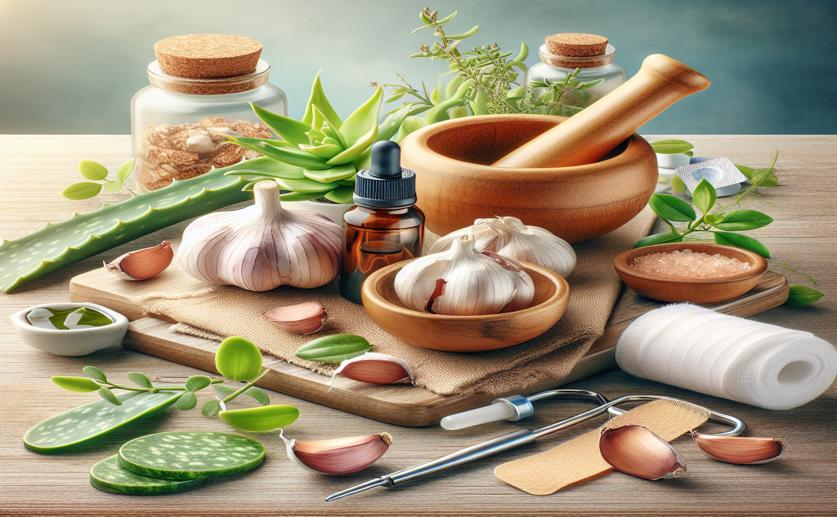
Garlic (Allium sativum), a common source of allicin.

Photo adapted from: Jonathunder / CC BY SA (Source)
Diabetic wounds pose a significant healthcare challenge, often failing to heal effectively and requiring extensive, costly treatment. This is due to a combination of factors, including impaired blood flow, nerve damage, and a weakened immune response in individuals with diabetes. A key issue is the reduced ability of cells responsible for repair – like stem cells – to migrate to the wound site[2]. Traditional treatments often struggle to fully address these complexities, prompting research into alternative therapies, particularly those utilizing naturally occurring compounds. Recent research from Universitas Airlangga[1] investigated the potential of allicin and quercetin, two bioactive substances found in common plants, to accelerate wound healing in diabetic rats. Allicin, derived from garlic, and quercetin, found in many fruits and vegetables, are known to possess anti-inflammatory and antioxidant properties. The study aimed to determine if a combination of these compounds, delivered in an emulsion (a mixture of oil and water), could improve the healing process. The researchers created diabetic wounds on the backs of Wistar rats, each measuring 1cm x 1cm. The rats were then divided into four groups. One group received no treatment, serving as a control. The other three groups were treated daily for seven days with different wound medicines, including a formula containing both allicin and quercetin. The researchers then monitored the wounds on days three and seven, assessing how much the wounds had contracted (shrunk in size) and examining tissue samples under a microscope – a process called histopathological examination. The results showed that the group treated with allicin and quercetin experienced significantly improved wound healing compared to the control group and the other treatment groups. Specifically, the wounds in this group contracted more, meaning they became smaller faster. Microscopic examination revealed increased blood vessel density and enhanced epithelialization – the process where new skin cells grow to cover the wound. These findings suggest that allicin and quercetin promote the formation of new tissue and improve blood supply to the wound area, both crucial for effective healing. This study builds upon earlier work demonstrating the benefits of cellular therapies, such as using adipose-derived stem cells (ASCs) to accelerate diabetic wound healing[3]. That research showed that ASCs, and substances they release, can enhance blood vessel growth (angiogenesis) and reduce inflammation – similar mechanisms proposed for allicin and quercetin. However, cellular therapies can be complex and expensive. The Universitas Airlangga study suggests a potentially simpler and more accessible approach using readily available natural compounds. Furthermore, the findings align with research highlighting the importance of addressing impaired cell migration in diabetic wounds[2]. While the current study doesn’t directly investigate cell migration, the improved angiogenesis observed could facilitate the delivery of cells and growth factors to the wound site, indirectly promoting repair. The use of an emulsion is also significant, as it helps to stabilize the allicin and quercetin, ensuring they remain effective, and maintains a moist wound environment, which is conducive to healing. Another study found that certain herbal creams outperformed standard antibiotic treatments in promoting diabetic wound healing in rats[4]. While that research focused on polyherbal formulations, it reinforces the idea that natural compounds can offer effective alternatives or additions to conventional wound care. The Universitas Airlangga study specifically identifies allicin and quercetin as potentially valuable components of such therapies.

MedicineHealthBiochem

References

Main Study

1) Management of wounds in diabetes by administering allicin and quercetin in emulsion form as wound medicine in diabetic rat models.

Published 5th February, 2024

https://doi.org/10.1515/jcim-2023-0177


Related Studies

2) Impaired cutaneous T-cell attracting chemokine elevation and adipose-derived stromal cell migration in a high-glucose environment cause poor diabetic wound healing.

https://doi.org/10.1016/j.kjms.2018.05.002


3) Acceleration of diabetic wound healing with adipose-derived stem cells, endothelial-differentiated stem cells, and topical conditioned medium therapy in a swine model.

https://doi.org/10.1016/j.jvs.2018.01.065


4) Comparative efficacy of two polyherbal creams with framycetin sulfate on diabetic wound model in rats.

https://doi.org/10.1016/j.jaim.2015.09.004


Related Articles

An unhandled error has occurred. Reload 🗙