How Leaf-Footed Bugs Developed Complex Weapons

Greg Howard
24th January, 2024

How Leaf-Footed Bugs Developed Complex Weapons

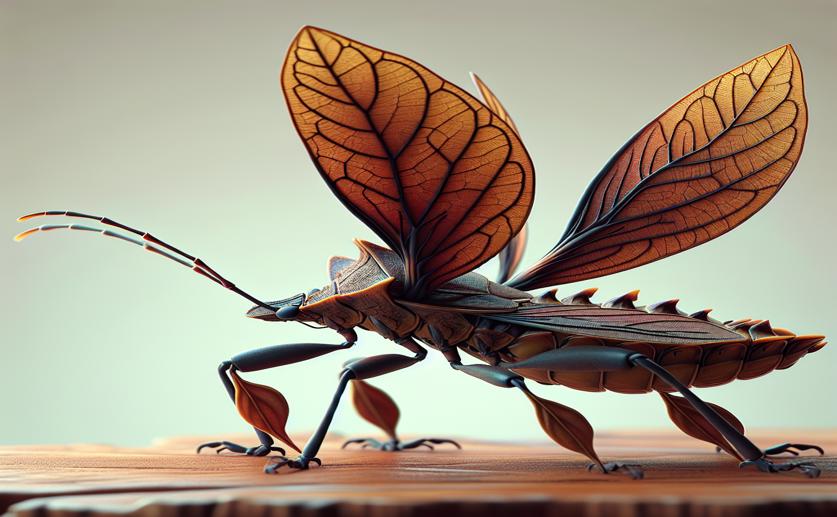
Narnia femorata, a type of leaf-footed cactus bug

Photo adapted from: Annika Lindqvist / CC BY (Source)
The evolution of physical traits used in animal combat, known as weapons, is a long-standing question in biology. These weapons – antlers, horns, tusks, spurs – vary dramatically in form, even among closely related species. Traditionally, studies have focused on the overall presence or absence of a weapon, or major changes in its size or shape. However, many weapons are actually composed of multiple parts, and understanding how these individual components evolve and combine is a more complex challenge. Researchers at the University of Florida[1] have now investigated this process in leaf-footed bugs, offering new insights into weapon evolution. The study focused on leaf-footed bugs (superfamily Coreoidea), insects where males possess elaborate weapons on their hind legs and bodies used to compete for mating territories. These weapons aren’t single structures, but are built from several distinct components. The research team aimed to determine how these components have evolved over time – whether weapons generally become more complex, simpler, or fluctuate in complexity. To achieve this, the researchers compiled a large genetic dataset from 248 different species of leaf-footed bugs. This dataset focused on “ultraconserved elements” – regions of the genome that change very slowly over evolutionary time, making them ideal for reconstructing evolutionary relationships. Using these genetic data, they inferred how the different weapon components had gained or lost throughout the evolutionary history of the group. This process is called ancestral state estimation, and it allows scientists to predict the characteristics of extinct ancestors. The results revealed a dynamic pattern of weapon evolution. Rather than a simple trend of increasing or decreasing complexity, the weapons of leaf-footed bugs appear to have added components over time, but also experienced periods of component loss, followed by further gains. This suggests a cyclical evolutionary pattern. Importantly, the study also found that certain combinations of weapon components evolved repeatedly across different branches of the leaf-footed bug family tree. This indicates that these specific combinations may be particularly effective in combat, or that the genes controlling these components are linked together, making them likely to evolve as a unit. This research builds on earlier work demonstrating that sacrificing body parts, a trait called autotomy, can evolve as a means of escaping predation[2]. While seemingly unrelated, both studies highlight the modular nature of evolutionary change – traits aren’t always evolving as single, unified entities, but can be assembled and disassembled from smaller components. In the case of autotomy, the ability to detach a limb evolved initially for reasons other than predator escape, and was later co-opted for that purpose. Similarly, the leaf-footed bug study suggests that weapon components may have initially evolved for one function, and then been combined in ways that enhanced fighting ability. The methods used in this study also benefit from advances in computational biology. The researchers relied on sophisticated techniques for analyzing large genetic datasets, similar to those used in other evolutionary studies[3]. These techniques allow scientists to reconstruct evolutionary histories with greater accuracy and detail than ever before. Interestingly, the findings also relate to broader patterns of sexual selection. Research has shown that there’s often a trade-off between traits used to attract mates (like ornaments) and traits used to compete with other males (like weapons)[4]. The evolution of weaponry in leaf-footed bugs may be influenced by the intensity of male-male competition within the group. Furthermore, the energetic costs of developing and maintaining weapons can also shape their evolution, as seen in birds where the need for efficient flight limits the development of heavy weaponry[5]. The leaf-footed bug study, while not directly addressing these trade-offs, provides a detailed look at the mechanisms by which weapon form evolves, offering a foundation for future research into the selective pressures that drive this evolution.

WildlifeEcology

References

Main Study

1) The evolution of multi-component weapons in the superfamily of leaf-footed bugs.

Published 22nd January, 2024

https://doi.org/10.1093/evolut/qpae011


Related Studies

2) The evolution of autotomy in leaf-footed bugs.

https://doi.org/10.1111/evo.13948


3) MAFFT: a novel method for rapid multiple sequence alignment based on fast Fourier transform.

Journal: Nucleic acids research, Issue: Vol 30, Issue 14, Jul 2002


4) Female monopolization mediates the relationship between pre- and postcopulatory sexual traits.

https://doi.org/10.1038/ncomms4184


5) Flight hampers the evolution of weapons in birds.

https://doi.org/10.1111/ele.13964


Related Articles

An unhandled error has occurred. Reload 🗙