Noise pollution linked to Parkinson’s-like symptoms and brain cell damage

Greg Howard
5th November, 2025

Noise pollution linked to Parkinson’s-like symptoms and brain cell damage

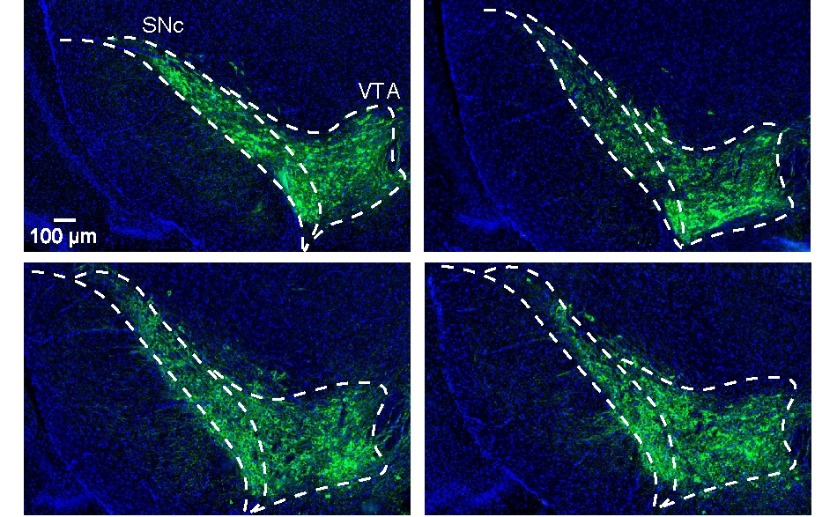
These images of dopamine-producing neurons (green) reveal that a single, acute exposure to loud noise can trigger temporary Parkinson's-like symptoms in vulnerable mice

Image adapted from: Cui et al. / CC BY (Source)

Key Findings

  • In an early-stage Parkinson’s disease mouse model, short-term noise exposure temporarily impaired movement, but did not cause neuron loss
  • Chronic noise exposure led to lasting movement problems and a reduction in dopamine-producing neurons in a key brain region affected by Parkinson’s disease
  • Noise exposure activates a specific brain circuit connecting the inferior colliculus to dopamine neurons, and manipulating this circuit can worsen or reverse movement issues
Parkinson’s disease (PD) is a neurodegenerative disorder primarily affecting movement, caused by the loss of dopamine-producing neurons in the brain. While genetic factors and environmental toxins[2] contribute to its development, the precise triggers and progression pathways remain incompletely understood. Increasingly, clinical observations suggest a correlation between exposure to environmental noise and the severity of PD symptoms, prompting researchers to investigate a potential link.[1] conducted by teams at Wuhan University of Science and Technology, Huazhong University of Science and Technology, Hubei University of Chinese Medicine, and Northwestern University, aimed to determine whether noise exposure directly impacts PD development and to identify the underlying biological mechanisms. The study utilized a mouse model of early-stage PD created by administering a low dose of 6-hydroxydopamine (6-OHDA), a chemical that selectively damages dopamine neurons. Researchers exposed these mice to either acute (short-term) or chronic (long-term) high-decibel noise. They observed that acute noise exposure induced temporary motor problems, while chronic exposure led to lasting motor deficits and a significant reduction in dopamine neurons within the substantia nigra compacta (SNc) – a brain region critically affected in PD. A key finding was the activation of the inferior colliculus (IC) in response to noise exposure. The IC is a brain structure involved in auditory processing and, crucially, it directly connects to the SNc dopamine neurons. Further experiments demonstrated that artificially stimulating the IC-SNc pathway could replicate the motor problems induced by noise, and conversely, inhibiting this pathway could reverse the effects of acute noise exposure. This strongly suggests that the IC-SNc circuit is a central mediator of noise-induced vulnerability in the PD model. To understand the molecular mechanisms at play, the researchers investigated changes within the SNc neurons. They discovered that noise exposure, and activation of the IC-SNc circuit, led to a decrease in levels of vesicular monoamine transporter 2 (VMAT2). VMAT2 is a protein responsible for packaging dopamine into vesicles, protective sacs that transport and store the neurotransmitter. Reduced VMAT2 levels impair dopamine storage, making neurons more susceptible to damage. Importantly, increasing VMAT2 levels in SNc neurons protected against the negative effects of noise exposure. These findings build upon previous research highlighting the complexities of PD pathogenesis[3]. While earlier studies have identified various risk factors, including pesticide exposure and traumatic brain injury[4], the role of environmental factors like noise had not been thoroughly investigated. This study offers a novel perspective, suggesting that even relatively common environmental stimuli can contribute to the development of PD, particularly in individuals at an early stage of the disease. The research also connects with findings about the importance of specific brain circuits in PD[3], specifically the parafascicular thalamic circuits and their projections to areas like the caudate putamen and subthalamic nucleus. Although the IC-SNc circuit wasn't previously identified as a key player, it shares the characteristic of being a specific neural pathway that can be targeted to potentially alleviate PD symptoms. Furthermore, the identification of VMAT2 as a critical protein offers potential therapeutic avenues. Strategies aimed at increasing VMAT2 levels in dopamine neurons could enhance their resilience to environmental stressors and slow disease progression. This study underscores the importance of considering environmental factors in the prevention and treatment of PD, and emphasizes the need for greater “environmental harmony” to protect neurological health.

EnvironmentHealthGenetics

References

Main Study

1) Environmental noise-induced changes to the IC-SNc circuit promotes motor deficits and neuronal vulnerability in a mouse model of Parkinson’s Disease

Published 4th November, 2025

https://doi.org/10.1371/journal.pbio.3003435


Related Studies

2) Influence of heavy metals in Parkinson's disease: an overview.

https://doi.org/10.1007/s00415-022-11282-w


3) Targeting thalamic circuits rescues motor and mood deficits in PD mice.

https://doi.org/10.1038/s41586-022-04806-x


4) The epidemiology of Parkinson's disease: risk factors and prevention.

https://doi.org/10.1016/S1474-4422(16)30230-7


Related Articles

An unhandled error has occurred. Reload 🗙